_1774494554973.webp)
How to choose the right size utility door mat
August 7, 2026


Choosing the right size utility door mat has a direct effect on how clean your building is, how safe it is, and how much it costs to maintain over time. When looking for entry mats for business projects, the right size will make sure that the mats catch the most dirt, cause the fewest accidents, and fit your budget. A proper-sized mat should stretch at least six feet into the entrance area to allow three full footfalls per guest. This will catch 80% of the trash that comes in before it hits the surfaces inside. This guide is designed to meet the specific needs of buying managers, project directors, and distributors who need scalable matting solutions that work well and don't cost too much for large-scale installations or multiple sites.
Understanding the Importance of Utility Door Mat Size
Undersized entrance mats cause major practical problems that go beyond how they look. When there isn't enough coverage, dirt and moisture skip right through the matting zone and land on your floors or carpeting inside. This speeds up the wear and tear on expensive floors and makes cleaning much more expensive. We saw places that spent 40% more on floor care every year because their utility door mats didn't cover half the suggested distance for footfall.
Different but equally expensive problems arise when mats are too big. Extra material bunches up around the edges, making trip hazards that could lead to liability claims against your business. When you pay for square footage that doesn't help you in any way, shipping and storage costs go up needlessly. The mat might also be too big for smaller doorways, forcing them to be put in an awkward place that makes it impossible for the door to swing open or meets accessibility standards.
If you get the right size, your doormat will go from being an afterthought for looks to being a useful tool. When shoes are the right size, they make full contact with the scraping surface more than once when they cross the threshold. This mechanical action gets rid of rough particles before they scratch terrazzo, cut carpet fibres, or make smooth tile slippery. Procurement teams know that mats that are the right size last 30 to 50 percent longer than mats that don't fit well, which gives them a measurable return on investment (ROI) through less frequent replacement and lower maintenance costs.
Key Criteria to Consider When Choosing Utility Door Mat Size
Assess Traffic Intensity and Flow Patterns
Industrial buildings, hotel lobbies, and shopping malls with a lot of foot traffic need utility Door mat units that are longer so that they can handle extra people during shift changes or busy times. For heavy foot traffic, manufacturing companies with 200 or more daily entries usually put in 10 to 15-foot mat runs. 6 to 8-foot sizes may be enough to cover office buildings with modest use. The direction of traffic flow is just as important. Single-direction doors let you place mats in a straight line, but multi-directional halls need a wider area to catch dirt from different approaches. Custom-cut shapes that follow real-life traffic patterns instead of standard rectangular dimensions work best for buildings with side entrances or doorways that are at an angle.
Match Environmental Conditions to Coverage Needs
Outdoor-to-indoor transitions need more aggressive sizing than doorways that lead inside. Mats that can hold a lot of water—usually 1.5 gallons per square yard—must be used at exterior entrances that are exposed to rain, snow, or construction zones. This means that the lengths must be at least 8 feet long to provide enough soaking capacity before they become saturated. Inside, going from one department or clean room to another needs less coverage, but it needs to be fitted perfectly so there are no gaps. The climate also affects the choice of materials and their sizes. For example, facilities in wet areas focus on their ability to hold water, while facilities in dry areas focus on their ability to capture fine dust. This changes the pile density and overall footprint that is needed.
Calculate Space Availability and Installation Constraints
Carefully measure the floor space you have available before giving measurements. Most building codes call for 32 to 36 inches of space around the door so it can swing freely. Recessed mat wells let you place them flat, but they only come in certain cavity sizes. Surface-mounted options give you more choices, but if the diameter is more than 0.25 inches, the edges need to be bevelled to meet ADA requirements.
Think about issues beyond the door. Mats need to be taken out every so often to be deep cleaned or replaced. Make sure that the size you choose can fit through hallways, lifts, and storage areas without having to be taken apart. This problem can be solved by modular mat systems, which divide large areas of coverage into sections that are easier to handle. However, seam maintenance is something that needs to be thought about.
Types and Materials of Utility Door Mats: How They Impact Size Selection
The makeup of the material directly affects the best size choices. Rubber utility door mats with drainage channels work great in wet areas, but they are very heavy—a 4x6-foot rubber mat can weigh 35 pounds or more. When the size is bigger than 6x10 feet, this extra bulk makes it hard to handle without mechanical help. Lighter carpet-top mats with plastic backing are easier to handle in bigger sizes, but they can't hold as much water.
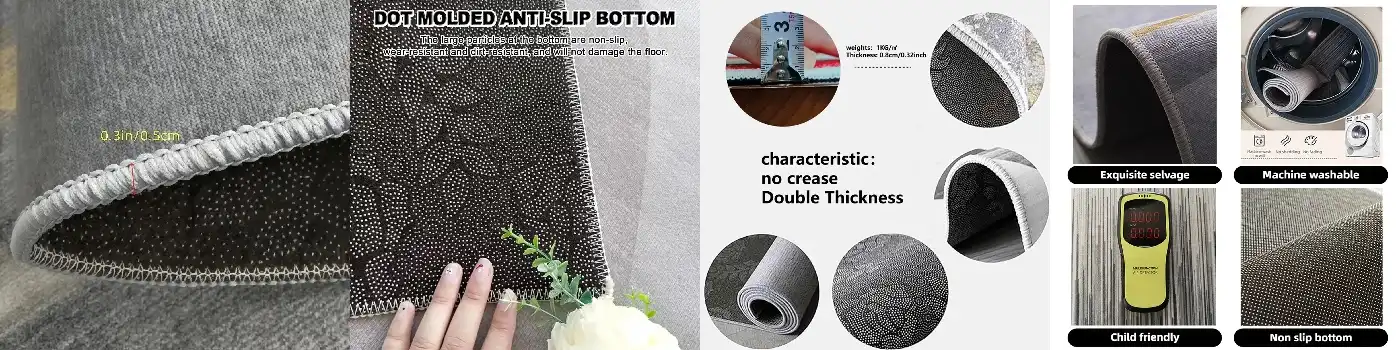
The combination of our fine faux-cashmere surface and TPR thermoplastic rubber backing makes it perfect for a wide range of uses. The soft but durable pile successfully scrapes off dirt and stays soft underfoot, making it perfect for places where the guest experience is important, like hotels and restaurants. The TPR backing gives it great grip without being too heavy like most rubber compounds, so it can be installed in sizes up to 10x15 feet without the need for special tools.
Performance and dimensional planning are both affected by thickness. Low-profile mats that are 0.25 to 0.375 inches thick work well for doors with limited space, but they may get flattened quickly when they're used a lot, so they need bigger surface areas to make up for it. Thicker builds (0.5 to 0.75 inches) keep scraping power longer, but door bottom clearance and barrier heights need to be carefully checked. Quality goods with machine-woven edge locking don't break no matter how thick they are, so the dimensions stay the same over the life of the product.
Your sizing options are greatly increased when you can customise. With the help of heat transfer printing and laser cutting, you can make any size or shape that you need. We can change the size and colour of your order starting at just 50 pieces MOQ, and we can add your logo in seven days or less. This versatility is very helpful for standardising mat programs across multiple locations with different entrance layouts, as it ensures brand consistency without sacrificing functional fit.
Practical Steps for Measuring and Selecting the Right Size Utility Door Mat
Accurate Dimensional Assessment
Correct Dimensional Evaluation: Measure your doorway's clear opening width at its narrowest point. This is usually where the door frame meets the floor. If there is room, add 4 to 6 inches to each side so that the utility door mat goes past the traffic path and catches people who come in at an angle. Write down how far the door threshold is from any obstacles, like welcome desks or secondary doors. This will give you an idea of the longest length you can use. Use masking tape to mark the full curve of the door swing design. No matter where you put the mat, it can't get in the way of the door working. Take pictures of the door from different points, if possible from above. When suppliers come up with solutions, these visual aids help them understand the space limitations, especially for custom configurations.
Traffic Volume Calculation
Track busy times over a week to figure out how many daily posts there are. When measuring traffic at industrial sites, shift change traffic should be kept separate from steady-state flow. Retail and hospitality buyers can benefit from looking at patterns during the week versus those on the weekends. Finding the average number of foot traffic per hour by dividing the daily entries by the working hours is the first step in figuring out the extra capacity needs.
As a starting point, use the three-footfall rule: multiply the average stride length (about 24 inches for adults) by three contacts (72 inches or 6 feet minimum length). This should be increased to four or five footfalls for high-traffic areas, resulting in 8- to 10-foot mat lengths. When projects are trying to stay within a budget, they may have to choose between width and length. This is because horizontal covering is more important for effectively capturing dirt.
Supplier Consultation and Sample Validation
Early on in the design process, talk to providers like Yiyajia. Our engineering team looks at photos of the site and traffic data to figure out what the best dimensions should be based on similar installations in the same industry. We make samples in 24 to 48 hours using the same heat transfer and laser cutting techniques that are used for production runs. This way, we can be sure that the final large order will be exactly the same as the test mat.
When you test samples in real-world working conditions, you find problems that you couldn't have seen on the models. Place test mats where they will be used most often and check how much dirt they pick up at the mat's edge. If you can see soil moving past the mat, it means the length isn't long enough. When edges curl or move when walking on them, it means that the backing material isn't thick enough or the coverage isn't wide enough. When scaling to full deployment across multiple sites, these real-world insights keep you from making mistakes that cost a lot of money.
Case Studies & Industry Examples of Right-Sized Utility Door Mats in Use
A factory in the Midwest cut its floor maintenance costs by 38% by replacing 3x5-foot entrance utility door mats that were too small with 6x12-foot heavy-duty runners that were the right size. The longer length caught metal shavings and cutting fluid leftovers that had to be mopped up every day on the work floor. The facility manager said that the extra money spent on properly sized mats paid for itself in nine months by cutting down on the cost of cleaning supplies and making the floors last longer.
A building with three entrances that serves 400 employees standardised on custom 4x8-foot logo mats with their company's name on them. The purchasing director chose sizes that would fit in existing mat wells and cover the most ground. CE and ROHS certifications made sure that their business environmental goals were met. The branded mats gave the area a more professional look and handled modest traffic loads well, showing that the right size can help with both practical and aesthetic goals.
A hospitality company that runs twelve boutique hotels set up a flexible mat program using 3x4-foot sections that could be put together in different ways to fit the entrance geometry of each property. The size was good for housekeeping teams because it was easy to handle for daily shake-outs and occasional cleaning. The standard module sizes made managing goods easier and worked with a wide range of buildings, from old ones with narrow doors to new ones with big lobby entrances. This example shows how a well-thought-out sizing strategy can help with chain-wide purchasing issues without sacrificing site-specific customisation.
Conclusion
There are a lot of things to think about when choosing the right utility door mat dimensions, such as the amount of traffic, the environment, available space, and your budget. Mats that are too small don't catch enough trash, and mats that are too big waste resources and put people in danger. The best way to do things is to check the actual conditions of the entrance, use the three-footfall minimum rule to figure out the amount of traffic, and make sure that the specifications are correct by working with suppliers and testing samples.
The practical size limits are affected by the material. Lighter constructions allow for larger single-piece installations, while heavier compounds may need modular approaches. Custom manufacturing eliminates the need to choose between standard sizes and the best fit. This is especially helpful for deployments that span multiple sites and need consistency across different entrance configurations. By giving dimensional planning the attention it deserves, procurement teams can improve the cleanliness of the building, its safety, and its long-term operational costs.
FAQ
Q1: What mat length works best for high-traffic industrial entrances?
A: Industrial sites with 200 or more daily openings should require lengths of at least 10 feet to properly collect dirt. Extending to 12 or 15 feet may be necessary if heavy equipment is going to be used or if the area will be exposed to mud and snow. The goal is to make sure that at least four full steps are taken on the utility door mat surface before workers reach the flooring inside. When money is tight, places that work with rough materials like metal shavings or concrete dust should choose length over width.
Q2: Can I order custom dimensions for bulk projects?
A: It is common for businesses to order things in custom sizes. We can use laser cutting to make any size mix, and the minimum order quantity (MOQ) for size and colour requirements starts at 50 pieces. Customising the logo only takes a short amount of time—usually seven days from the acceptance of the artwork. Our daily production capacity of 2,000 square meters can handle large projects without long delays. This means that custom dimensions are possible even for tight construction schedules or phased rollouts in multiple locations.
Q3: How does mat size affect maintenance schedules?
A: When it comes to service times, bigger mats may need to be cleaned more often because they can hold more dirt. If the mat is the right size and gets moderate traffic, it might only need to be vacuumed once a week instead of every day for an undersized mat. It doesn't matter what the material is made of; our machine-woven construction with edge locking keeps its shape through multiple washings, while cheaper mats shrink or curl. Plan for maintenance access when choosing a size. Mats that are bigger than 6x10 feet may need to be cleaned by a professional instead of being handled in-house.
Partner with a Reliable Utility Door Mat Manufacturer for Your Bulk Projects
Yiyajia Carpet specialises in making custom utility door mats that are made to last in tough commercial and industrial settings. With our advanced heat transfer printing, we can make logos and other branding elements look very clear, and with our precision laser cutting, we can make any size or shape without damaging the structure. Before it is shipped, each mat goes through strict quality control measures such as tuft bind strength tests and dimensional stability proof. This makes sure that all of your mats will work the same way.
Our CE and ROHS certifications give your projects the proof of compliance they need, especially when they're going into regulated industries or export markets. The fine fake cashmere surface has a refined look and good scraping action, making it perfect for business and hospitality settings. The TPR backing provides good grip without being too bulky. We keep clear production schedules with manageable lead times, and our strong logistics partnerships make sure that your goods get through customs without a hitch and arrive on time at your distribution centers around the world.
Get in touch with our technical sales team at sale@yyj-carpet.com to talk about your specific traffic and size needs. We'll make size suggestions based on similar installations and send you verification samples within 48 hours. Yiyajia is your practical partner for scalable mat programs that balance performance with procurement efficiency. Whether you need the same dimensions in 50 places or custom configurations for specialised facilities, our flexible production approach and low MOQ limits make us the best choice.
References
1. National Floor Safety Institute. "Walkway Matting Systems: Performance Standards and Sizing Guidelines for Commercial Applications." NFSI Technical Bulletin Series, 2021.
2. Chen, Robert and Martinez, Sofia. "Cost-Benefit Analysis of Entrance Mat Systems in Commercial Facilities." Journal of Building Maintenance and Operations, Vol. 34, No. 2, 2022, pp. 145-162.
3. American Society for Testing and Materials. "ASTM D7570: Standard Test Method for Dimensional Stability of Textile Floor Coverings." ASTM International, West Conshohocken, PA, 2020.
4. Hoffman, David K. "Entrance System Design: Optimizing Mat Coverage for Traffic Patterns." Facility Engineering Journal, Spring 2023, pp. 78-91.
5. International Sanitary Supply Association. "Clean Building Standards: Soil Containment at Building Entrances." ISSA Technical White Paper 720-2022, 2022.
6. Wong, Catherine L. and Thompson, James R. "Material Selection and Sizing Strategies for Industrial Entrance Matting Systems." Industrial Safety and Maintenance Quarterly, Vol. 18, No. 4, 2023, pp. 203-218.