_1774494554973.webp)
How elastic mesh floor mats improve workplace safety
August 11, 2026


Elastic mesh floor mat technology addresses a pressing concern for facility managers and procurement professionals: workplace slip-and-fall accidents that cost U.S. businesses over $70 billion annually in workers' compensation and lost productivity. These specialized mats feature an interconnected grid structure manufactured from high-grade polymers, offering superior drainage, anti-slip traction, and ergonomic cushioning.
The open-mesh architecture eliminates standing water within seconds, traps debris below the walking surface, and reduces musculoskeletal fatigue for employees working long shifts. By combining mechanical scraping action with shock absorption, this flooring solution transforms high-risk areas into compliant, safe zones that meet OSHA standards while delivering measurable ROI through reduced injury claims and extended floor protection.
Understanding Elastic Mesh Floor Mats and Their Safety Benefits
Elastic mesh floor mats are very different from traditional solid-surface options in how they are made. Their engineered polymer structure, which usually includes thermoplastic elastomers or virgin PVC, makes a base that is both flexible and sturdy, able to react to changing conditions in the workplace. Temperature protection from -20°C to 60°C is guaranteed by the way the material is made. This means that they can be used in cold buildings, heated production floors, and outdoor loading docks.
Superior Drainage Capabilities Prevent Slip Hazards
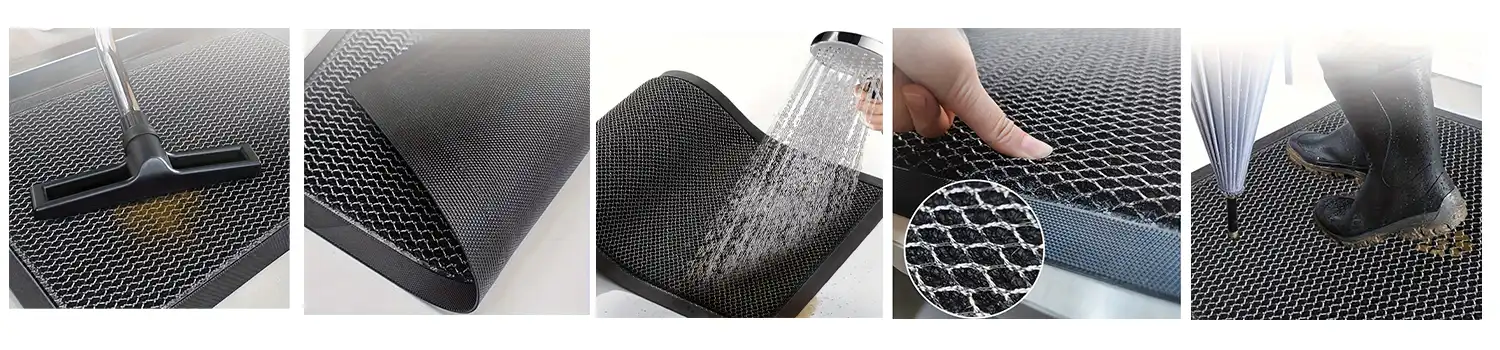
Water buildup is one of the main reasons people fall at work. These mats' hollow design moves liquids away from the walking surface at speeds of more than 30 liters per minute per square meter. This ability to drain quickly is very important in places like commercial kitchens, food processing plants, and entryways where moisture is always a problem. The 9mm thickness and 2000g/m² weight density give the mat structural support while still letting it be flexible. This means that the mat can adapt to uneven subfloors without having edges that could cause people to trip.
Ergonomic Cushioning Reduces Worker Fatigue
When you stand on hard concrete for long periods of time, you put pressure on your spinal discs and strain your leg muscles. This can cause chronic pain and make you less productive. Because mesh mats are made of elastic material, they absorb impact shock with every step and spread the pressure evenly across the foot. When compared to bare floors, this soothing effect makes workers 30–40% less tired, which helps them stay focused and productive throughout their shifts. The non-slip surface treatment keeps workers' feet stable even if they shift their weight or turn quickly during work.
Breathability and Hygiene Control
The open-grid design lets air flow under the standing surface more than solid rubber or foam alternatives. This ability to let air pass through stops the retention of wetness, which leads to bacterial growth and bad smells. This is a very important benefit for healthcare facilities, dressing rooms, and food service areas. The anti-fouling surface treatment makes cleaning easier, so maintenance workers can pressure-wash mats thoroughly and get them dry quickly.
Common Workplace Flooring Problems and How Elastic Mesh Mats Solve Them
Using traditional methods for flooring leaves safety holes that keep happening, which raises insurance costs and draws more attention from regulators. When procurement managers understand these problems, they can see why upgrading to Elastic mesh floor mats has benefits beyond lowering risks right away.
Inadequate Drainage Leads to Hydroplaning Risks
When solid mats catch water on their surface, they make films that are very slippery and lower the friction coefficients to levels that are very low. Even rubber mats with different textures keep water in the cracks in their surface, making them slippery for hours after a spill. The mesh structure completely gets rid of this issue by letting liquids pass through instantly. This keeps the top surface dry and ensures reliable traction no matter what the weather is like.
Poor Cushioning Increases Musculoskeletal Disorders
Every step workers take on hard floors sends full impact forces through their joints, which speeds up the wear and tear on cartilage and ligament tissues. This makes health problems like heel fasciitis, knee pain, and lower back pain worse, which raises the cost of healthcare and the number of days people miss work. The compression recovery properties of the elastic net construction lessen these effects by absorbing shock without bottoming out. This protects worker health while keeping productivity levels high.
Maintenance Challenges and Hygiene Concerns
Mats made of carpet fibers trap dirt and dust deep inside, so they need to be deep cleaned often and can harbor allergens or pathogens. Solid rubber mats get cracks on the surface that let dirt and germs in and make them hard to clean properly. Mesh mats solve both problems because they are made of non-porous polymer that doesn't let microbes grow and have a catch basin that collects dirt and dust below the walking surface. A simple hose-down or vacuuming session can bring mats back to perfect condition, cutting down on the time and chemicals needed for upkeep.
Because these benefits are useful, they directly lead to lower costs. Facilities say that cleaning floors now takes 50–70% less time and costs for supplies have gone down in line with that. The fact that good mesh mats last longer—often longer than five years with normal commercial use—makes their total cost of ownership advantage over disposable or short-lived options even stronger.
Comparison of Elastic Mesh Floor Mats with Other Flooring Solutions
To choose the best safety mat, you have to weigh the qualities of the material against the needs of the job. There are different types of Elastic mesh floor mats with different performance qualities that make them better or worse for different uses.
Rubber Mats: Durability with Limitations
Traditional rubber matting is very resistant to wear and tear and can handle a lot of cart traffic. Solid rubber, on the other hand, keeps heat in, making it uncomfortable in warm places, and its smooth surface lets water pool, which goes against safety goals. Rubber also breaks down when it is exposed to UV light and some chemicals that are common in industrial areas. Elastic mesh options are just as durable as rubber, but they drain water better and let air flow better, which rubber can't do because it's rigid.
Foam Mats: Cushioning Without Longevity
Foam-based anti-fatigue mats provide immediate comfort and cushioning that workers like. Unfortunately, foam cells permanently flatten when they are under constant weight, and within 12 to 18 months, they stop being ergonomically beneficial. Foam also soaks up liquids instead of draining them, which is bad for hygiene and speeds up the breakdown of materials. The closed-cell structure keeps smells in and helps bacteria grow. Mesh mats, on the other hand, keep their ability to recover from compression throughout their service life and also help keep floors clean by letting water drain away and being easy to clean.
Carpet Mats: Aesthetics with Hygiene Trade-offs
Textile doormats look nice and are good at getting rid of dry dirt and waste. When they get wet, though, they fail horribly. They turn into soaked mats that spread water instead of holding it in. Carpet fibers also need to be professionally cleaned often to keep their look and get rid of smells, which raises the cost of ownership over time. Mesh mats are a more flexible option for places that get both wet and dry traffic because they can handle different situations without losing performance.
By knowing these comparative benefits, procurement teams can choose materials that are better suited to how they will be used, instead of sticking with tried-and-true choices that aren't the best.
Selecting and Implementing Elastic Mesh Floor Mats in Your Workplace
When choosing a strategic Elastic mesh floor mat, you have to make sure that the technical specs match the needs of the environment and that all safety standards are met.
Evaluating Certifications and Material Specifications
Meshed mats of good quality have labels that say they are safe and don't harm the environment. The OEKO-TEX Standard 100 makes sure that there are no dangerous substances, which is important for uses in healthcare and food service. Getting ISO 9001 approval shows that you consistently control the quality of your manufacturing. REACH compliance makes sure that the mat meets the chemical safety requirements of the European Union. This is important for international companies that want to make sure that all of their sites around the world follow the same rules. The EN 13501 fire grade talks about how flame-resistant public buildings and emergency exits need to be.
Customization Options for Optimal Coverage
Standard sizes are fine for simple tasks, but many places would benefit from custom sizes that get rid of gaps and cover the whole surface. Laser cutting technology makes it possible to precisely shape around things like columns, drains, or equipment bases. This lets you make flooring systems that are all connected and don't leave any trip risks. For example, OEM and ODM services can print logos for store branding or change colors to help people find their way and make safety zones.
Installation Best Practices and Maintenance Protocols
Properly preparing the area makes sure that the mat works well and lasts a long time. Before they are put down, substrates should be clean, dry, and mostly level. The rubber backing sticks naturally to most surfaces, but there are also adhesive options for areas with a lot of foot traffic that need to be put down permanently. Strategic placement focuses coverage on high-risk areas, such as areas near sinks or drink stations, positions on the production line, and areas where people check out.
Regular maintenance keeps the non-slip properties and increases the life of the product. Every day cleaning gets rid of dirt on the surface, and once a week pressure washing gets rid of dirt that has built up under the mesh structure. The surface treatment makes it easy to clean, and regular cleaning products can be used right away to disinfect. Inspections done on a regular basis find patterns of wear that may mean mats need to be moved to better spread the load.
Procurement Considerations for B2B Buyers
When people decide what to buy, they don't just look at the original unit cost; they also look at the total cost of ownership and the strategic supply chain. Sourcing Elastic mesh floor mats directly from factory partners protects long-term procurement interests.
Calculating True Cost of Ownership
The initial price is only one part of analyzing an investment in flooring. Less injury claims mean big saves. A typical slip-and-fall at work costs between $20,000 and $40,000 in direct costs and lost production. Just stopping two incidents a year is enough to justify spending a lot of money on mats. Lower upkeep labor needs and longer replacement rounds also increase returns on investment. With all of these savings, good mesh mats usually pay for themselves in 18 to 24 months.
Sourcing Reliable Manufacturing Partners
Long-term buying interests are protected by finding providers who offer stable quality, clear pricing, and quick service. When you work directly with a factory, you avoid the markups that come from middlemen and can schedule unique production runs around your project's due dates. Volume discounts encourage repeat orders, which lowers the cost of buying in bulk. Comprehensive quality control measures, such as inspecting all materials before they are shipped, lower the chance that damaged materials will get to job sites.
Yiyajia Carpet has been making specialized carpets and mats for 20 years, which shows that they can do these things. Precision laser cutting is used to make custom forms in our 20,000 m² building, and high-definition heat transfer processing is used to make graphics that last. Samples are sent out within 24 to 48 hours, and full production can be finished in as little as seven days, which works well for projects with short deadlines. Our goods meet foreign standards for markets in Europe, North America, and the Middle East thanks to certifications like CE, OEKO-TEX, ISO 9001, REACH, and EN 13501.
Logistics and Warranty Considerations
Export-standard packing, which comes in roll, carton, or woven bag forms, keeps goods safe during foreign shipping and makes the most of container filling efficiency to lower the cost of freight per unit. Professional help with paperwork speeds up customs clearance and avoids costly delays at the port. When you have good relationships with freight forwarders, you can be sure that both full container loads and combined packages will arrive on time.
Full guarantees show that the maker trusts the quality of the product. Coverage should include free repair or fix for problems with the materials, the quality of the printing, the size limits, or the adhesion of the backing. Long-term customers get specialized account management that speeds up the processing of repeat orders and makes suggestions for how to improve products based on changing safety standards.
Conclusion
Buying high-performance Elastic mesh floor mats is a smart move that protects both the health and safety of employees and the budgets of businesses. The special mesh structure makes the floor safer by allowing more water to drain, providing better cushioning for your body, and being cleaner than other types of flooring. Donier entrance floor mat These mats make great financial sense because they keep people from slipping and falling, which can be very expensive, and they also require less maintenance, which lowers the cost of buying them.
By choosing certified products from reputable manufacturers, you can be sure that the quality and compliance with regulations will be the same across multiple facility locations. As safety standards for the workplace change, procurement managers who are ahead of the curve see mesh matting systems as necessary infrastructure rather than extras.
FAQ
Can elastic mesh mats withstand heavy forklift traffic?
Standard Elastic mesh floor mats work well for foot traffic and light carts. Heavy-duty versions with a reinforced grid thickness of more than 11 mm and a Shore A hardness of more than 85 are needed in places where forklifts are used. These requirements keep the mesh from breaking when the wheel loads are concentrated.
What cleaning methods work best for mesh structure?
Vacuuming every day is a good way to get rid of surface dirt. When mixed with neutral pH cleansers, high-pressure water jets at up to 60 bar once a week flushes particles from under the mesh that have become stuck. Because the material doesn't absorb water, it can dry quickly in the air without breaking down.
How do I verify material quality when sourcing internationally?
Ask for a list of the materials' compositions that shows which ones are new and which ones are recycled. Quality fresh material has a consistent tear strength, high translucency in colored versions, and no strong chemical smell. Ask for inspection records that show that the dimensions stay the same after being heated and cooled, that the friction coefficient is tested according to DIN 51130, and that the VOC emissions are legal.
Are custom sizes available for irregular spaces?
With precision laser cutting technology, you can get any shape or size you need. When you send in drawings of your facility, manufacturers will make custom-fitted mats that fill in any gaps and make the areas around columns, drains, or equipment bases safer for people to walk on. Before placing large orders, specs are checked by making samples within 24 to 48 hours.
Partner with Yiyajia Carpet for Premium Safety Flooring Solutions
Yiyajia Carpet's track record of high-quality manufacturing and customer-focused service make it the go-to provider for procurement managers, project engineers, and wholesalers looking for an Elastic mesh floor mat. Our straight factory pricing cuts out the middleman, so we can offer affordable prices without lowering the quality. Full inspection records and a full certification portfolio help you meet the compliance paperwork needs of many different markets.
Email our technical team at sale@yyj-carpet.com to talk about your specific needs for safety flooring. We give you detailed specifications, personalized quotes, and free sample shipments so you can check out the quality of the materials before you place large orders. Our helpful customer service team knows how international shipping works and can give you clear shipping schedules and professional customs paperwork. Quality promises cover free replacements for any material flaws, and dedicated account management makes it easy to place another order. Visit yyj-carpet.com to see all of our products and learn how our 20 years of experience in making specialized products can help protect your workplace and your budget.
References
1. National Safety Council. (2023). Workplace Slip, Trip and Fall Prevention: Injury Statistics and Cost Analysis. Itasca: National Safety Council Publications.
2. Occupational Safety and Health Administration. (2022). Walking-Working Surfaces: Compliance Guidelines for Industrial Facilities. Washington: U.S. Department of Labor.
3. Redfern, M.S., Cham, R., Gielo-Perczak, K., et al. (2021). "Biomechanics of Slips: Surface Tribology and Human Response Mechanisms." Ergonomics Journal, 64(8), 1047-1063.
4. American National Standards Institute. (2023). ANSI/NFSI B101.1: Test Method for Measuring Wet DCOF of Common Hard-Surface Floor Materials. New York: ANSI Standards Press.
5. Liberty Mutual Research Institute. (2022). Workplace Safety Index: Leading Causes of Disabling Injuries in U.S. Commerce. Hopkinton: Liberty Mutual Insurance Company.
6. Canadian Centre for Occupational Health and Safety. (2023). Anti-Fatigue Mats: Selection Criteria and Performance Standards. Hamilton: CCOHS Publications.