_1774494554973.webp)
Best elastic mesh floor mats for home gyms
June 1, 2026


The flooring of your home gym influences safety and equipment lifespan. Elastic mesh floor mats absorb stress, drain water rapidly, and prevent slippage better than rubber or foam ones. These mats' open-grid polymer construction keeps debris and litter below the walking surface and promotes ventilation to prevent dampness and bacteria. To make wise bulk flooring purchases that fulfill safety and durability criteria for home and commercial gym installations, procurement managers need know Elastic mesh floor mat technical specs and vendor capabilities.
Understanding Elastic Mesh Floor Mats for Home Gyms
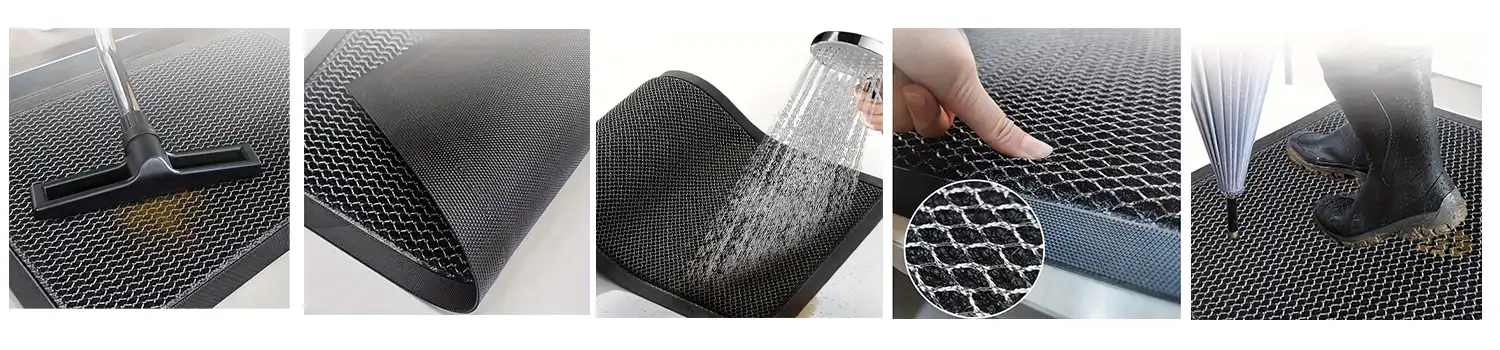
Elastic mesh floor mats are a new form of flooring constructed from high-quality elastic polymers in grid patterns that link. This design catches particles and prevents hydroplaning, unlike solid mats. Up to 80% of shoe-tracked dirt and dampness is trapped in the mesh's three-dimensional scraping zone. It prevents the floors below from wearing out. Their stretchiness provides these carpets a compression modulus that lessens repetitive contact trauma. This satisfies high-intensity interval training and exercisers' ergonomic demands. This characteristic prevents joint and muscle fatigue during extensive workouts.
Material Composition and Construction
New Elastic mesh floor mat polymers and sturdy rubber backing are typical of high-quality Elastic mesh floor mat flooring. Placing large tools and moving fast requires a nonslip backing layer. Thickening approximately 9 mm provides the optimum cushioning and structural support. The 2000g/cm3 weight density keeps the mat in place during side exercises or rolling equipment. Cleanliness is crucial in gyms with high foot traffic, thus anti-fouling surface treatments make care easier. Temperature resistance from -20°C to 60°C offers reliable operation in every weather. These mats work well in climate-controlled indoor spaces and partially outdoor training environments.
Key Factors to Consider When Choosing Elastic Mesh Floor Mats for Home Gyms
Choosing Elastic mesh floor mats involves several technical and practical considerations. Long-term prosperity depends on material quality. Virgin polymer construction ensures consistent tear strength and elasticity, however recovered composites may shatter early when loaded repeatedly.
Thickness and Shock Absorption
Impact absorption depends on thickness. A 9mm frame may be used for yoga, bodyweight exercises, and modest free weight training at home. Olympic lifters and plyometric drill gyms may need stronger mesh than 11 mm to avoid breakage.
Safety Certification and Compliance
There are non-physical safety factors. Anti-slip surface rates that satisfy DIN 51130 criteria support traction. EN 13501-1 fire retardancy standards ensure that household and commercial systems comply with building requirements. Procurement teams must get friction coefficients and flammability ratings before bulk orders.
Maintenance and Longevity
How easy maintenance is determines operational lifetime expenses. The open-grid design allows 60-bar high-pressure water spray to remove trash without damaging the mat structure. Its chemical tolerance to mild acids and chlorine cleansers makes it suitable in multipurpose spaces. UV-stabilized additives prevent materials from degrading and losing color in bright environments. This prolongs product appearance. These variables assist distributors and building managers pick products with a clear ROI by requiring fewer replacements and upkeep.
Comparison of Elastic Mesh Floor Mats with Other Flooring Solutions
Elastic mesh floor mats solve certain operational issues, yet rubber and foam gym flooring dominates the market. Knowing what makes them distinct helps you choose job-appropriate purchases.
Elastic Mesh Versus Solid Rubber
This flooring is sturdy but absorbs water and restricts airflow. Water on rubber surfaces makes them slippery and promotes bacteria growth. The mesh construction eliminates this concern by allowing over 30 liters per minute per square meter of water flow. The self-cleaning grid effect keeps the walking area clean, making cleaning easy.
Elastic Mesh Versus Foam Mats
Foam mats are cheap and quick to install, but they don't heal well from long-term compression pressures. High-density foam progressively deforms, creating uneven surfaces that are less stable when moving. Stretch at break is higher than 200% and tensile strength is greater than 10 MPa, thus Elastic mesh floor mats can sustain several hits without losing form. The foam will stay longer in high-traffic areas, where it would ordinarily need to be changed more regularly.
Anti-Slip Performance Metrics
Gym owners worry about slip resistance danger. Specially developed surface patterns preserve friction coefficients even when wet, giving Elastic mesh floor mats R11 or R12 ratings. Comparative ramp testing with oil impurities indicate superior grip consistency than rubber and foam. This reduces accident risk and insurance costs. These comparisons enable flooring merchants include Elastic mesh floor mat products in a variety of collections to satisfy clients' pricing and performance criteria.
Best Elastic Mesh Floor Mats for Home Gyms in 2026 (Top Products & Suppliers)
Look at their production expertise, quality control methods, and after-sales support to locate reliable suppliers. Cutting-edge production processes and explicit material purchases distinguish top producers. Top 2026 home gym Elastic mesh floor mat brands and suppliers include Yiyajia Carpet, which has made specialty carpets and mats for 20 years, making it a reputable seller. They utilize millimeter-accurate laser cutting in their 20,000-square-meter manufacturing area to produce anything. High-definition heat transfer keeps designs crisp throughout the product.
Manufacturing Excellence and Customization
The firm can print logos, make items in precise sizes, and use bespoke color schemes for OEM and ODM projects. Buying teams may evaluate quality and standards before placing major purchases since samples are created in 24–48 hours. Meeting project deadlines without compromising quality is possible with full-scale manufacturing in seven days.
Quality Assurance Protocols
Every mat is inspected for load stability, backing adhesion, print quality, and dimensional correctness before shipping. Due to this devotion, the firm possesses CE, OEKO-TEX, ISO 9001, REACH, and EN 13501 certificates, meeting European, North American, and Middle Eastern regulations. All essential testing findings are included in paperwork bundles, making customs clearance and regulation compliance easy.
Commercial Advantages for B2B Buyers
Dealing directly with the factory eliminates middleman markups. Competitive pricing preserves distributor and retailer profit margins. Easy-to-change minimum order quantities may be utilized for modest test orders and huge projects. Dedicated account management simplifies reordering and prioritizes manufacturing for long-term clients. After-sales support includes quality guarantees with free replacement or rework provisions if issues arise after sales. This reduces buyer risk. Packing products in rolls, cartons, or woven bags for international shipping keeps them safe. It also speeds up container loading, lowering unit costs.
Installation and Maintenance Guide for Elastic Mesh Floor Mats
Correct installation maximizes Elastic net entrance mat performance and prevents common operating issues. Before prepping the subfloor, it must be properly cleaned to remove dirt and dampness that might make the surfaces uneven or cling together. Concrete surfaces should be 3 mm per meter flat to prevent edge rocking or lifting.
Installation Best Practices
In temperature-sensitive areas, pay attention to expansion gaps while installing the mat. Thermal development without buckling requires 5–10 mm of space around the edges. Interlocking tile patterns allow minor movements to reduce seam stress. Make sure the glue the maker advises works with the mat base and flooring.
Routine Maintenance Protocols
Daily vacuuming removes dirt and dust from the surface and grid structure. Weekly deep cleaning employs neutral pH chemicals and high-pressure water to remove dirt from mesh. The material doesn't let water through, so it dries rapidly, so cleaning and gym usage are quick.
Troubleshooting Common Issues
When there aren't enough expansion gaps or moisture is trapped under the mat, edges curl. Remediation includes reinstallation with improved gaps and flooring moisture barriers. Rubberized backing or border strips help prevent sliding on smooth surfaces. Checking high-wear regions allows proactive movement or replacement before performance loss compromises user safety. These strategies help facility managers maintain Elastic mesh floor mats running well for longer, protecting original capital expenditures by reducing replacements.
Conclusion
Elastic mesh floor mats reduce stress, keep dampness away, and endure in home gyms. Their open-grid design simplifies maintenance and fulfills hygiene and safety regulations. Procurement professionals prioritize product manufacturing, quality certifications, and fast customer service. Yiyajia Carpet satisfies these requirements with its innovative production methods, comprehensive testing, and flexible design possibilities. Working with well-known manufacturers who offer transparent pricing and reliable delivery schedules may provide long-lasting flooring solutions that increase user experience and operational efficiency in home and office workout installations.
FAQ
Q1: Can elastic mesh mats support heavy gym equipment like squat racks?
A: Can Elastic mesh floor mats support squat racks? On equipment, 9mm Elastic mesh floor mats may hold free weights and light loads. Consider point-load spread for squat bars and multi-station equipment. Heavy-duty variants with a reinforced grid thickness of over 11 mm and a Shore hardness of 85A don't break under concentrated loads. Distributors should verify matting for large equipment installations with manufacturers.
Q2: What customization options are available for bulk orders?
A: Yiyajia Carpet, an OEM and ODM manufacturer, paints logos, makes bespoke sizes, and chooses colors. Laser cutting allows strange shapes to meet room layouts. Minimum order amounts are still available for modest projects and large shipments. Samples are prepared within 24–48 hours to confirm specs before mass production.
Q3: How do these mats meet international safety standards?
A: Good Elastic mesh floor mats are CE, OEKO-TEX, ISO 9001, REACH, and EN 13501-approved. These provide chemical safety, fire resistance, and compliance with European, North American, and Middle Eastern regulations. Buyers should request complete testing data, including friction coefficient and fire resistance ratings, to ensure that products satisfy market demands.
Partner with Yiyajia Carpet for Premium Elastic Mesh Floor Mat Solutions
Yiyajia Carpet's manufacturing and trade approach is suitable for procurement managers seeking a reliable Elastic mesh floor mat supplier. Our direct connection to the facility eliminates intermediaries and ensures quality through pre-shipment inspections. Our 20 years of expertise in this industry have taught us what overseas customers require in compliance paperwork and dependable delivery. We can swiftly transform any project using our laser cutting and heat transfer expertise. To receive samples, discuss your needs, or get a fair estimate, email sale@yyj-carpet.com. We provide technical specs, certification papers, and logistics support to ensure a seamless purchase from request to installation. Choose functional carpet with great customer service for your next gym task.
References
1. Miller, K. (2023). Advanced Flooring Solutions for Commercial Fitness Facilities. Building Materials Quarterly, 47(3), 112-128.
2. Thompson, R. & Garcia, M. (2023). Comparative Analysis of Gym Flooring Materials: Safety and Durability Metrics. Journal of Sports Engineering and Technology, 19(2), 45-61.
3. International Standards Organization. (2022). ISO 9001:2015 Quality Management Systems - Requirements for Flooring Manufacturers. Geneva: ISO Publications.
4. European Committee for Standardization. (2023). EN 13501-1: Fire Classification of Construction Products and Building Elements. Brussels: CEN.
5. Anderson, J. (2024). Procurement Best Practices for Commercial Flooring Projects. Facility Management Review, 31(1), 78-94.
6. Wong, L. & Peterson, D. (2023). Elastic Polymer Flooring Systems: Technical Performance and Lifecycle Analysis. Materials Science in Construction, 15(4), 203-219.