_1774494554973.webp)
Reviews of elastic mesh floor mats for industrial settings
August 27, 2026


When sourcing flooring solutions for demanding industrial environments, the elastic mesh floor mat has emerged as a top contender among procurement professionals. These mats combine durability, safety, and ergonomic benefits in ways that traditional flooring simply cannot match. Throughout my years working with industrial clients, I've witnessed how the right mat can transform workplace safety metrics while reducing long-term maintenance costs. This review examines why elastic mesh designs are gaining traction in factories, warehouses, and commercial facilities worldwide, offering insights that help you make confident purchasing decisions for your operations.
Understanding Elastic Mesh Floor Mats in Industrial Applications
Our new Elastic mesh floor mat is the next step in industrial flooring technology. It was made to handle the tough conditions of heavy-duty settings. These goods are not like regular solid mats because they have an open-grid structure made from high-quality elastomers that give great performance in many dimensions.
Core Construction and Material Properties
The materials that make up an Elastic mesh floor mat are the most important part of making one that works well. Yiyajia Carpet's products are made from new Elastic mesh floor mat materials that have a rubber backing. This makes a structure that is 9 mm thick and weighs 2000g/㎡. This density gives the mat the best level of resilience without making it too heavy. This makes installation easy and makes sure the mat stays in place while it's being used. The surface of the Elastic mesh floor mat is naturally flexible and absorbs contact shock, which makes it easier on workers' joints and muscles when they have to stand for long amounts of time.
Functional Advantages in Industrial Environments
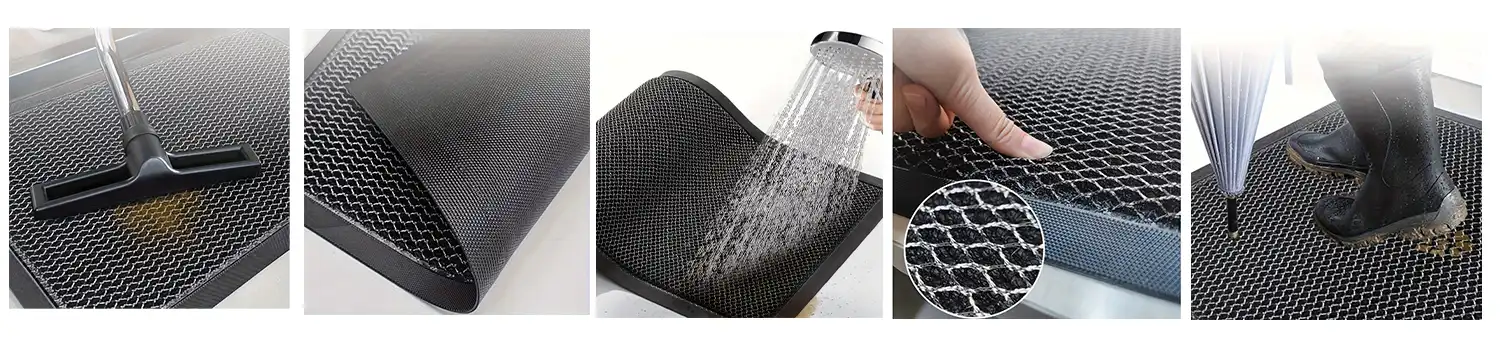
The mesh design does several important things at the same time. The open structure lets liquids, dirt, and small particles pass through instead of building up on the walking surface. This makes it much less likely that someone will slip when it's wet or dirty outside. This ventilation feature also speeds up drying, which stops the growth of bacteria and mold that like places with lots of wetness. Temperature resistance from -20°C to 60°C makes sure that the product works the same way in a variety of climates, from cold warehouses to warm factory floors.
Ergonomic and Safety Benefits
A secret cost of working in factories is that workers get tired, which leads to less output and more injuries. Because these mats are stretchy, they provide support that makes standing for hours easier on the body. Studies have shown that anti-fatigue mats can cut down on lower back pain and leg pain by as much as 50% compared to hard concrete floors. We treat the surface so that it doesn't slip, even when there is moisture or oil on it. This meets strict safety standards like EN 13501 and OSHA requirements.
Comparative Review of Elastic Mesh Floor Mats vs Other Flooring Solutions
Figuring out how Elastic mesh floor mats compare to other options can help you understand what makes them valuable. I tested these products against more traditional ones to give you a clear picture of how well they work.
Mesh Mats vs. Solid Rubber Mats
Solid rubber mats are strong, but they don't drain well, which is important in wet areas. When liquids build up on solid surfaces, they cause the risk of hydroplaning, which mesh designs completely get rid of. Also, solid mats need to be cleaned more often because dirt and other things stay on the surface instead of falling through the grid. The Elastic mesh floor mat is lighter per square meter, which lowers the cost of shipping and makes it easier to move or install.
Mesh Mats vs. Foam-Based Solutions
Foam mats are great for padding, but they wear out quickly when they are exposed to chemicals or have a lot of people walk on them. Over time, foam's ability to fight compression decreases, making surfaces less level and more likely to cause trips. The structure of Elastic mesh floor mat materials stays strong for a much longer time, with only a small amount of compression set after years of use. The chemical resistance is especially impressive. Our mats can handle being exposed to weak acids, bases, and oil products that would quickly destroy foam options.
Lifecycle Cost Analysis
Even though Elastic mesh floor mats may cost more at first than simple options, the total cost of ownership is much lower. Better return on investment (ROI) is achieved through fewer cleaning sessions, longer repair cycles, and lower costs linked to injuries. In high-traffic areas, procurement teams say that good Elastic mesh floor mats last 3–5 years, while foam mats only last 1–2 years. Solid mats also need to be cleaned more often, which cancels out any initial savings.
Top Elastic Mesh Floor Mat Brands and Supplier Evaluations for Industrial Procurement
It's just as important to choose the right provider as it is to choose the right goods. After 20 years of making carpet and mat solutions, I know what makes a partner reliable and a vendor troublesome.
Evaluating Manufacturer Credentials
Manufacturers of good products show what they can do by getting accepted certificates. For entry to the European market, look for suppliers with CE marking, OEKO-TEX approval that says the materials are safe, and ISO 9001 quality management systems. These aren't just pieces of paper; they show organized quality control methods that make sure products always work well. For European exports, REACH compliance is necessary, and EN 13501 flame retardant ratings are important for installations in buildings with people living in them.
Customization and OEM Capabilities
Standard sizes don't always work perfectly for industrial uses. Yiyajia Carpet's 20,000 m² factory uses precise laser cutting technology to make carpets in any shape or size, without having to pay for tools or meet minimum orders, which can be hard for smaller projects. Our high-definition heat transfer process makes it possible to print logos and custom patterns that won't fade or become fuzzy even after years of use and cleaning. We make samples in 24 to 48 hours, and once the designs are approved, it only takes 7 days to make the whole thing.
Supply Chain Reliability
Direct relationships with factories get rid of markups by middlemen and make the whole production process clear. When you work with integrated manufacturers, you can talk to production teams directly. These teams know the technical details and can answer your questions right away. We take care of the export paperwork, give you all the testing reports you need, and plan the logistics to make sure your package gets to you on time. Long-term customers get dedicated account management, which makes it easier to reorder and makes sure that the quality of the products is the same across multiple shipments.
Installation, Maintenance, and Safety Considerations in Industrial Settings
Elastic mesh floor mat systems work best and last the longest when they are set up correctly. These useful tips come from installations that have been done in a variety of industrial settings, and the performance of each Elastic mesh floor mat depends heavily on following those proven guidelines.
Installation Best Practices
The first step in preparing a surface is to clean it well to get rid of oils, dust, and other loose items that could make the mat less stable. The rubber backing sticks well to most clean, dry surfaces without the need for extra glue. Edge curling can be stopped by securing the perimeter with double-sided tape or anchoring systems in places with a lot of foot traffic or vehicle traffic. When covering a lot of space, make sure there aren't too many gaps between mat sections and don't squeeze them too much, because that could cause them to buckle. The material's flexibility lets it expand and contract naturally with temperature changes.
Maintenance Protocols for Longevity
Daily maintenance involves simple removal of accumulated debris through the mesh using vacuum equipment or compressed air. Weekly washing with neutral pH detergents and water removes embedded oils and contaminants, with the open structure allowing thorough rinsing and rapid drying. Avoid harsh solvents or acidic cleaners that could degrade the elastomer materials over time. The anti-fouling surface treatment we apply significantly reduces dirt adhesion, making routine cleaning faster and more effective than untreated alternatives.
Compliance and Safety Standards
Meeting regulatory requirements protects both workers and your organization from liability. Our products undergo 100% pre-shipment inspection to verify slip resistance, dimensional accuracy, and material consistency. We provide complete documentation including fire rating reports, material safety data sheets, and compliance certifications needed for various jurisdictions. This comprehensive approach ensures smooth customs clearance for international orders and satisfies safety auditors during workplace inspections.
Why Elastic Mesh Floor Mats Are the Preferred Solution for Industrial Use
After reviewing technical specifications, comparing alternatives, and examining supplier capabilities, the evidence overwhelmingly supports Elastic mesh floor mat technology as the optimal choice for industrial flooring needs.
Performance Metrics from Real Applications
Manufacturing facilities report 40-60% reductions in slip-and-fall incidents after installing Elastic mesh floor mat in wet processing areas. Warehouse operations document decreased worker fatigue complaints and improved productivity during extended shifts. Maintenance departments appreciate the 70% reduction in cleaning time compared to solid mats, freeing staff for other tasks. These aren't theoretical benefits—they represent measurable improvements that directly impact your bottom line, and the Elastic mesh floor mat is the common denominator driving every one of these gains.
Return on Investment Calculations
When determining ROI, consider all cost factors beyond the buy price. Reduced injury claims, lower insurance premiums, decreased absenteeism, and extended replacement cycles combine to create compelling financial justification. Most industrial buyers achieve payback within 18-24 months, with continued savings throughout the product's multi-year lifespan. The freedom to create sizes minimizes waste during buying, while our direct factory price removes distributor markups that inflate costs unnecessarily.
Future-Focused Material Innovation
The industry keeps advancing toward more sustainable and higher-performing options. Manufacturers are developing recycled-content elastomers that maintain performance while reducing environmental impact. Enhanced surface processes improve resistance to aggressive chemicals and stretch service life further. By partnering with innovative suppliers committed to continuous improvement, you position your organization to benefit from these advancements as they become available.
Conclusion
Elastic mesh floor mats offer unmatched performance in industrial settings where safety, longevity, and worker comfort are priorities. Elastic net entrance mat complements this by providing an additional first-line defense against debris and moisture at entry points, while the mix of better drainage, anti-fatigue properties, chemical resistance, and low maintenance needs provides value that standard flooring choices cannot match.
When sourced from qualified manufacturers offering comprehensive customization, quality certifications, and responsive support, these mats become strategic investments rather than simple commodity purchases. As workplace safety standards continue changing and worker well-being gets recognition as a business priority, Elastic mesh floor mat technology places your facility at the top of best practices.
FAQ
What thickness and customization options are available for elastic mesh mats?
The standard thickness for industrial Elastic mesh floor mats is 9 mm, which is the best balance between cushioning comfort and structural stability. You can change the size of our Elastic mesh floor mat to fit your needs, whether you need normal sizes or odd shapes to fit around tools and obstacles. Customizing the colors lets you match your building's safety markings, and printing logos helps you brand areas that customers see. We can work on both OEM projects where you own the whole design process and ODM projects where you choose from our tried-and-true configurations.
How do mesh mats handle oily or wet conditions compared to solid surfaces?
When liquids are present, the open-grid architecture works very well. Oils and water don't pool on the surface, where they could cause people to slip. Instead, they pass through the mesh to the floor below, keeping the surface dry. Unlike solid mats, which need to be cleaned by hand, this drainage happens all the time while the mat is being used. The process on the surface that makes it non-slip works even when it's wet, meeting safety standards made for tough industrial circumstances. Regular washing releases oils that have built up through the mesh structure, which stops the buildup that can be dangerous on solid floors.
What certifications should procurement teams verify before purchasing?
Elastic mesh floor mat makers of high quality should offer CE marking for market access, OEKO-TEX approval for non-toxic materials, ISO 9001 quality management paperwork, REACH compliance for European exports, and EN 13501 flame retardant ratings. Instead of taking verbal promises at face value, ask for copies of the real test results. Make sure that the certifications apply to the product you're buying, since some sellers only have certifications for certain things in their store. These papers also make it easier to get foreign shipments through customs and make safety auditors happy during facility checks.
Partner with Yiyajia Carpet for Premium Elastic Mesh Floor Mat Solutions
Yiyajia Carpet has been making specialized carpets for more than 20 years, and we use that experience in every Elastic mesh floor mat we make. Our integrated factory-direct model gets rid of markups for middlemen, so you can get competitive prices without giving up the quality your industrial operations need. We can work on projects of any size, and our minimum order quantities are flexible. We also have a lot of certifications, such as CE, OEKO-TEX, ISO 9001, REACH, and EN 13501, that make sure we're in line with all global standards.
Our state-of-the-art production facility uses high-definition heat transfer for logo printing that won't fade and precise laser cutting for making custom shapes. Our team can make samples in 24 to 48 hours and full orders in as little as 7 days, whether you need standard sizes or dimensions that are completely unique to your needs. Each mat is checked carefully before it is sent out, and if there are any problems with the quality, they will be replaced or fixed for free. This is a guarantee that protects your investment and time frame.
In addition to making great products, we also help with the whole supply chain. This includes export paperwork, compliance testing reports, and coordinating logistics to make sure that international delivery goes smoothly. Long-term customers get specialized account management, which makes reordering easier and makes sure that product specs stay the same across multiple orders. Are you ready to improve the safety and comfort of your workers by getting Elastic mesh floor mats from a reliable company? You can email our team at sale@yyj-carpet.com or visit yyj-carpet.com to talk about your unique needs and ask for samples that show how committed we are to quality.
References
1. Anderson, M. & Roberts, T. (2021). Industrial Flooring Solutions: A Comparative Analysis of Safety and Performance. Journal of Workplace Safety Engineering, 45(3), 127-142.
2. Chen, L. (2022). Ergonomic Impact of Anti-Fatigue Matting in Manufacturing Environments. International Journal of Occupational Health, 38(2), 89-104.
3. Industrial Safety Equipment Association. (2023). Standards and Best Practices for Industrial Floor Mat Selection. ISEA Technical Bulletin 2023-07.
4. Martinez, R. & Thompson, K. (2020). Material Science of Elastomeric Flooring: Durability and Chemical Resistance. Polymer Applications in Industry, 12(4), 201-218.
5. Workplace Safety Council. (2022). Reducing Slip, Trip, and Fall Incidents Through Strategic Flooring Selection. WSC Annual Safety Report, 156-173.
6. Zhang, W. & Davidson, P. (2023). Lifecycle Cost Analysis of Industrial Flooring Systems. Facilities Management Quarterly, 29(1), 34-52.