_1774494554973.webp)
How to install imitation sisal carpet yourself: step-by-step guide
June 26, 2026


When done properly, installing imitation sisal carpet is a simple process that produces expert results. With this imitation sisal carpet option, the natural texture of traditional sisal is imitated, and it also has better longevity, stain protection, and waterproofing. Procurement managers, contractors, and building teams can make installations that are smooth and up to business standards if they plan ahead and use the right tools. This guide will walk you through every important step, from knowing the material specs to finishing touches, so you can confidently carry out any job, whether it's a hotel renovation, a storefront upgrade, or a home improvement.
Understanding Imitation Sisal Carpet and Installation Basics
What Defines Quality Imitation Sisal Carpet
Imitation sisal carpet that works well is made of solution-dyed polypropylene or polysilk threads that are designed to look like natural basketweave designs. Unlike biological fibers, these materials don't absorb water (at a rate of about 0.01%), so they don't get watermarks or mold growth, which are problems with natural fibers.
The backing system, which is usually TPR, point plastic, or silicone strips, keeps the dimensions stable, which is very important for installing from wall to wall. Products with high-density tufted structures (10–15 mm thick, 1-2 kg/m² weight) give buyers the realistic feel they want while still meeting EN 1307 standards for Class 32/33 business wear.
Comparing Material Options for Your Project Needs
The look of natural sisal is organic, but it breaks down quickly in damp places and needs special care. Imitation sisal carpet options get rid of these weaknesses while keeping the same look. When looking at different suppliers, you should look at their UV stability rates (Grade 7-8 on the Blue Wool Scale), tuft bind strength according to ASTM D1335 standards, and chemical protection. OEKO-TEX approval means that a product's ingredients are safe, which is especially important for healthcare and leisure settings where indoor air quality is important.
Essential Tools and Terminology for Professional Results
For a successful installation, you'll need certain tools, like utility knives with hooked blades for clean cuts, straight edges for precise cutting, knee kickers for stretching, and seam rollers for a strong bond. Being familiar with key terms makes it easier to work with installation teams. "Acclimatization" means letting carpet rolls get used to room temperature for 24 to 48 hours. This keeps the carpet from bowing after it has been installed. "Grinning" refers to backing that can be seen at seams, which can be avoided by properly tensioning. "Barring" means that there are horizontal lines in the weave design. This is usually a problem with the quality of the production rather than a fitting mistake.
Preparing for Installation: Site Assessment and Surface Preparation
Evaluating Subfloor Conditions and Moisture Levels
Before putting down any flooring, you should carefully check the subfloor. Calcium chloride tests shows that concrete floors must be completely dry (usually at least 60 days) and have wetness levels below 3%. For wood subfloors, you need to check for rot, squeaks, and bending that is more than 1/360 of the span length. Imitation sisal carpet is one option that requires similar subfloor preparation, and moisture barriers that are applied directly to concrete surfaces work well in high-traffic business areas like hotel hallways and store doors. They keep water from breaking down adhesive bonds over time.
Surface Preparation Steps for Optimal Adhesion
First, use industrial vacuums and scrapers to get rid of all the trash, old glue residue, and other contaminants. Use the right patching solution to fill holes bigger than 1/8 inch, and then sand them smooth after they have dried. Over 10 feet, the floor must be level within 3/16 inch so that there are no bumps that can be seen through the carpet. To make it easier for things to stick to concrete, it's often necessary to shot blast or grind the surface to open up the pores. Apply the primer according to the instructions that came with the glue. Usually, you need to wait two to four hours for it to dry before moving on.
Accurate Measurement and Layout Planning
Since walls don't always run straight, you should measure the size of a room from more than one spot. Find the total square footage and add 10% for waste in cases where the plan is complicated and there are a lot of gaps. When planning the direction of your carpet, you should think about natural light sources and traffic patterns. The strands reflect light in different ways based on their orientation, which changes how colors are seen. In business settings, seams should be placed away from main paths, where people walk and wear them down quickly. Use chalk snappers to draw reference lines that will help you keep things square during installation.
Step-by-Step Installation Process of Imitation Sisal Carpet
Material Acclimatization and Initial Cutting
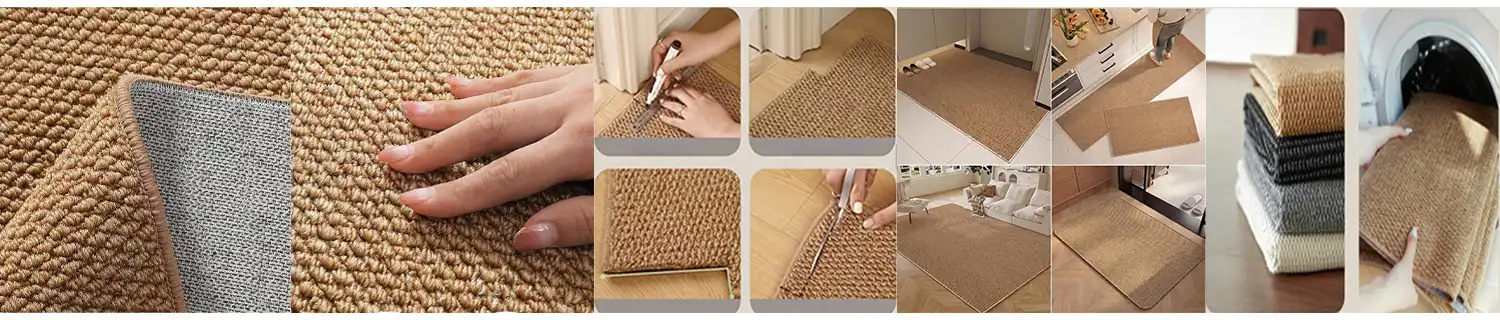
Keep the temperature in the installation area between 65°F and 85°F while you unroll the carpet. It takes this long for imitation sisal carpet strands to relax and backing materials to settle in terms of their shape. If you need to cut the carpet, lay it face down on a clean surface. Straight edges and new blades are best. When pulling the knife toward you, make one long stroke instead of scoring it over and over, which wears down the edges. At first, leave 3 inches of extra space on all sides; cutting to fit is the last step after stretching.
Adhesive Application or Tack Strip Installation
The attachment method relies on the type of material and the amount of flow that is expected. When used with 1/16-inch notched trowels to make even covering, pressure-sensitive adhesives are great for portable installs. Full-spread adhesives must be put onto both the base and the carpet backing for permanent installations in high-traffic areas, and they must be left to dry for the required amount of time, which is usually 10 to 20 minutes. Instead, tackless strips placed 1/2 inch from the walls around the outside provide mechanical grip when paired with padding underneath. However, this method works better for home projects than for business ones.
Positioning, Stretching, and Seaming Techniques
To keep the carpet from getting wrinkled, work from the middle outward as you lay it down on wet glue. Knee kickers pull fabric tight against walls that are opposite each other, getting rid of the slack that makes things buckle. If you have to sew something, cut both pieces at the same time with a straight edge to make sure they are perfectly lined up. Put seam sealer on the back edges, and then use a 75-pound seam roller to press them together tightly. Before the surface skinning happens, roll the seams within the adhesive's working area. The goal is to have changes that can't be seen, with patterns that line up perfectly with no holes or overlaps.
Final Trimming and Edge Finishing
Once the carpet is fully stuck down and spread, use wall trimmers or utility knives pushed up against straight lines to cut off any extra material along the walls. To keep the edges from tearing, cut from the face side at a 45-degree angle. Imitation sisal carpet requires the same careful edge finishing to prevent fraying.
Edges should be tucked under baseboards or transition strips should be put in at doors that fit the profile of the carpet. Edge strips made of metal or vinyl protect the edges of entrances and other places that don't have walls. Before letting people walk on the floor, vacuum the area well to get rid of any installation waste. Usually, you have to wait 24 hours for the glue to fully cure.
Maintaining Your Imitation Sisal Carpet for Longevity
Cleaning Protocols That Preserve Appearance
Solution-dyed polypropylene fibers don't fade easily, but they still need to be maintained regularly. Every day, vacuum high-traffic areas with machines that have spinning brushes to get rid of dirt and dust before they damage the fibers. Imitation sisal carpet, on the other hand, can handle being cleaned with wet drainage three times a year, which is a big plus in restaurant settings.
Use pH-neutral soaps that have been softened according to the manufacturer's instructions to treat spills right away. Blot the area instead of rubbing it to keep the fibers from getting damaged. Many commercial-grade items can handle bleach solutions that are diluted (1:10) to get rid of tough spots without losing their color.
Preventive Measures for High-Traffic Commercial Areas
Put walk-off mats at the exits to catch dirt and water in the first 15 feet of travel. This can cut soil transfer by up to 80%. To keep chairs and tables from getting lasting compression marks, move the furniture around every so often in places with static loads. Even though most imitation sisal carpet has UV stabilizers built in, use window films that block UV rays in places that get direct sunlight. Professional deep cleaning with hot water extraction should be done every six months. This will recover the look of the carpet without damaging the synthetic fibers or backing systems.
Troubleshooting Common Installation Issues
Wrinkling usually happens because the base wasn't stretched enough during fitting or because water got through it. If problems happen during the warranty time, you should re-stretch the damaged areas with power stretchers. Edge lifting at seams means that the adhesive wasn't spread out enough or that the roller pressure wasn't right during installation. Add more glue and weight the area for 24 hours. If you can see the backing at the seams ("grinning"), you need to re-cut and re-seam the fabric so that the design lines up better. If you put ice cubes in permanent indentations made by heavy furniture, they usually go away in 24 to 48 hours, but furniture pads work better in the long term.
Procurement and Supplier Guidance for Imitation Sisal Carpet
Evaluating Manufacturer Credentials and Certifications
Suppliers with a good reputation keep a number of quality badges that prove they meet production standards. ISO 9001 certification shows that quality management systems are consistent, and REACH compliance proves that chemicals are safe for use in European markets. If you're choosing materials for hotels, shops, or public places where fire rules apply, look for EN 1350 flame retardant grades.
OEKO-TEX Standard 100 approval makes sure that textiles are safe and don't contain any harmful chemicals. This helps address health issues in schools and hospitals. Manufacturers who offer CE marking follow EU safety rules, which makes the buying process easier for people from other countries. Customizable imitation sisal doormat is an ideal option for those needing both durability and design flexibility, as it can be tailored to specific sizes and patterns while maintaining natural fiber properties.
Bulk Order Procedures and Customization Options
Different suppliers have different minimum order amounts, but for custom requirements, they usually start at container load sizes (500–1000 square meters). MOQs for standard items may be smaller. OEM services allow for full customization, such as adding a name through heat transfer printing, making changes to the size through precise laser cutting (which can handle irregular forms), and matching the color to the building's specs. With an ODM plan, you can choose from designs that have already been made with only small changes. When production schedules and quality review rules are taken into account, lead times run from 15 to 30 days for standard items and 45 to 60 days for fully customized orders.
Logistics and Delivery Considerations
Export packaging standards protect packages while they are being shipped across international borders. Some choices are roll wrapping that doesn't absorb water, reinforced box packaging for cut pieces, or woven bag packaging for large orders. Professional sellers figure out the best ways to load containers so that the most space is used in each one, which lowers the cost of freight per unit.
Established makers keep working together with freight forwarders to make sure that both FCL and LCL shipping goes smoothly and that customs paperwork is clear. Keep a close eye on shipping schedules because late shipments can throw off project schedules, especially for building companies that have to meet tight deadlines.
After-Sales Support and Long-Term Partnership Benefits
Quality suppliers give return customers their own account managers, which speeds up the reordering process and gives them priority schedule for production. Technical support teams help with installation problems and give advice when situations in the field are different from what is expected.
Most of the time, manufacturing flaws like delamination, excessive shedding, or color differences that are too big of an issue are covered by warranties. Some makers train distributor teams on how to install their products or put buyers in touch with qualified installation partners. This is especially helpful when entering new markets where workers don't have experience with specialty flooring.
Conclusion
It takes careful planning, the right tools, and high-quality materials to put imitation sisal carpet successfully. Professionals can make projects that last for a long time and work well in busy business settings by following routines for assessing the substrate, using the right adhesive application methods, and carefully cutting and seaming the materials.
Because imitation sisal carpet is waterproof and doesn't stain, and because it looks natural, it's perfect for places like hotels, offices, stores, and homes where natural fibers would fail. When you work with certified makers, you can get solutions that are tailored to your needs, reliable delivery, and ongoing expert support. This lowers the risks of projects and helps your business grow over the long term.
FAQ
Can imitation sisal carpet be installed over existing vinyl flooring?
Imitation sisal carpet can be laid over vinyl flooring that is already there. It is possible to install over vinyl as long as the old surface is flat, well-adhered, and doesn't have any raised designs that could show through. Clean the surface well and use a primer made for non-porous surfaces. To keep binding problems from happening again, heavy-textured or loose vinyl should be taken off. Before you do a full repair, you should always test your chosen adhesive method on a small area first.
How does pile height affect commercial performance?
Low-pile imitation sisal carpet (0–1 mm) works great in business areas with a lot of foot traffic because it doesn't mat down and looks good for longer than deeper piles. The minimum height also makes it easier to get doors open and lessens the chance of tripping at changes. When paired with thick backing systems, slightly higher constructions strike a good balance between visual softness and practical sturdiness for catering applications that value aesthetic warmth.
What distinguishes entry-level from premium synthetic sisal products?
Premium choices have solution-dyed fibers all the way through instead of just treating the surface. This makes sure that the color goes all the way through for better fade resistance. The quality of the backing changes a lot. TPR and silicone strips are better at keeping their shape than basic rubber. High-end imitation sisal carpet goods have UV stabilizers built into the polymer matrix, and they can achieve tighter weave standards that make the texture of natural sisal look more like it does in real life, while still meeting industrial wear rates.
Partner With Yiyajia Carpet for Premium Imitation Sisal Carpet Solutions
When you need an imitation sisal carpet, you can trust Yiyajia Carpet to give you exactly what you need. They offer precision-engineered flooring options and have strict quality control measures in place. Our high-definition heat transfer technology lets you change the patterns in any way you want, and laser cutting makes sure that the sizes of both regular and unusual forms are exact. With CE, OEKO-TEX, ISO 9001, and REACH certifications, which ensure compliance across global markets, every order goes through a full review before it is shipped.
We offer variable MOQs, quick samples within 24 to 48 hours, and export-grade packing that is designed to make the most of container space. Dedicated account managers make contact easy, make production schedules clear, and offer full help after the sale. Email us at sale@yyj-carpet.com to talk about your needs for large purchases and find out how our OEM/ODM services give distributors, contractors, and business buyers around the world a competitive edge.
References
1. Anderson, P. R. (2021). Commercial Flooring Installation Standards and Best Practices. Flooring Industry Publications.
2. Chen, L. & Williams, M. (2022). "Synthetic Fiber Performance in High-Traffic Applications." Journal of Textile Engineering, 48(3), 127-145.
3. European Committee for Standardization (2020). EN 1307:2020 Textile Floor Coverings - Classification. Brussels: CEN Publications.
4. Miller, S. (2023). Complete Guide to Commercial Carpet Specification and Installation. Construction Trade Press.
5. Roberts, K. & Thompson, J. (2022). "Comparative Durability Analysis of Natural versus Synthetic Sisal Flooring." Building Materials Research Quarterly, 15(2), 89-103.
6. Zhang, H. (2023). Modern Carpet Manufacturing: Technologies and Quality Control Systems. International Textile Institute.