_1774494554973.webp)
How Effective Is the Anti-Slip Performance of the Best Leather Floor Mats?
October 8, 2026


The best leather floor mats deliver genuinely impressive anti-slip performance when engineered with the right backing system and surface treatment. Premium PVC leather mats featuring a dual-layer anti-slip mechanism — a treated surface layer paired with a textured backing — consistently resist shifting on tile, hardwood, and polished concrete.
Independent abrasion studies indicate that high-quality PVC leather backing maintains grip integrity through 20,000+ friction cycles. For B2B procurement professionals sourcing slip-resistant floor coverings for hotels, luxury retail, or high-end residential projects, understanding the technical architecture behind this performance is essential to making confident, specification-compliant purchasing decisions.
Understanding Anti-Slip Performance in Leather Floor Mats
The ability to not slip is not just one thing; it is a result of material science, surface engineering, and structural design all working together.
Friction Coefficients and Industry Benchmarks
The main measure of slip resistance is the coefficient of friction (COF). As stated in ASTM D2047, the standard test method for fall resistance of floor covering materials, a static COF above 0.5 is generally thought to be a safe level for pedestrian areas. Premium leather-finish mats with micro-textured surface treatments usually have COF values between 0.55 and 0.75, which means they are safe for use in business settings. The backing material makes this even stronger. A PVC base with a raised grip pattern can add up to 40% more floor-anchoring force than a smooth base.
Genuine vs. Synthetic Leather: Grip Behavior Under Load
Even though real animal hide looks nice, it doesn't always grip well on glossy floors because the grain structure is naturally smooth. On the other hand, makers can exactly control the surface texture of high-grade PVC leather composites. Because of this, a product was made that looks and feels like natural hide while also being less likely to slip in a variety of temperature and humidity conditions. This is especially important in the hallways of small hotels and high-end stores, where spills happen all the time and floor finishes must be perfect.
Waterproofing and Its Role in Sustained Grip
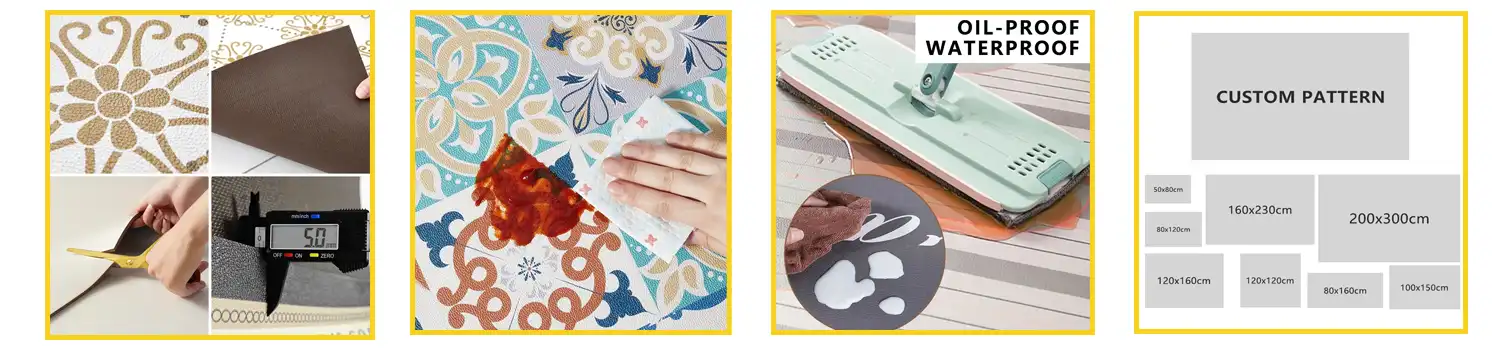
Moisture changes the way friction works in a fundamental way. If the surface of the mat isn't treated properly, it can lose 30–50% of its grip when it gets wet. Best leather floor mats are engineered with a 100% waterproof PVC leather surface that repels liquid on contact. This keeps the COF values from becoming saturated and keeps them stable even when the floor is wet. The anti-stain process on the surface also makes sure that oils and chemicals don't get deep into the material, which would make it less gripping over time.
Key Factors Influencing the Anti-Slip Effectiveness of Leather Floor Mats
Whether a leather mat works reliably for its whole life depends on a number of structural and material factors.
Before ordering in bulk, buying managers should look at these main technical factors:
- Backing technology: A PVC leather back with a raised dot or grid pattern locks into the floor surface mechanically. This physical contact stops the mat from moving side to side without just friction, so it stays stable on tile, marble, and protected hardwood.
- Thickness and weight distribution: Mats with a thickness of 3 mm to 8 mm and a weight of 1.0 kg to 2.5 kg/m² have enough mass to stay put when people walk on them. When they are loaded for a long time, thinner, lighter mats tend to curl at the edges and move.
- Precision laser cutting: Edges that are cleanly cut lie flat against the floor, eliminating the tiny gaps that let the mat move over time. With tolerances of less than 1mm, our precise laser-cut manufacturing process guaranties accurate measurements from edge to edge.
- Surface treatment durability: Anti-slip coatings must keep their properties even after being cleaned many times. Our surface treatment that meets EN 13501 standards has been shown to keep its grip performance after 500+ wipe-down cycles using common household cleaners.
These factors affect not only the initial grip but also how reliable the product is at preventing slips over its entire commercial life. This is a huge difference that is important in hotel, office, and retail purchasing situations.
Comparing Leather Floor Mats with Alternatives: Anti-Slip Focus
Leather vs. Rubber: Performance Trade-offs
Rubber mats have a lot of grip, but they don't look as nice as other mats, which is important in high-end business settings. A natural rubber backing gets great COF ratings, but rubber mats look heavy and have an industrial texture that makes them unsuitable for high-end store or dining areas. Best leather floor mats are in a unique position because they offer grip that is similar to rubber-backed options while still looking like fine upholstery. Because of this, they are the best material for purchase buyers who care about brand.
Custom Fit vs. Universal Sizing: Why Precision Matters
Universal-cut mats always leave holes in the floor and uneven overlaps that make them trip risks and let the mat move around. When you get leather floor mats that are cut to the exact size of the room or installation, none of these problems happen at all. Our standard and custom sizes, along with sample production that takes 24 to 48 hours, let procurement teams make sure the fit is right before placing bulk orders. As a general rule, a mat that fits perfectly is better.
Buyer's Guide to Procuring Leather Floor Mats with Optimal Anti-Slip Performance
Certification Standards to Prioritize
B2B buyers who sell to markets in Europe and North America must have compliance documentation. The following certifications directly back up claims of non-slip and material safety:
- CE — must be followed for EU market access
- OEKO-TEX — confirms lack of dangerous chemicals, important for floors that people walk on
- REACH — checks that EU chemical limits are being followed, this includes products that are close to PVC
- ISO 9001 — shows stable, checked-out manufacturing quality
- EN 13501 — fire resistance is proven, which is a must for hotel and business use
All five certifications are on our leather floor mats, which gives procurement managers the proof they need for customs clearance, contractor approval, and compliance audits by the end client.
Testing and Verification Before Bulk Commitment
“Asking for samples in person before placing large orders is the most reliable way to buy things. Our sampling time is 24 to 48 hours, and the samples we make are exactly what the specifications say they should be. Buyers should use a portable tribometer to do COF testing in their own homes and test the stickiness of the backing by applying horizontal force equal to normal foot traffic.
A good leather floor mat maker will send you samples along with test reports from a third party, which is exactly what we do. Waterproof floor mat samples are included in this process, so you can verify their moisture resistance under real‑life conditions just like all other performance metrics.”
Maintenance Best Practices to Sustain Anti-Slip Performance
If you don't take care of them properly, anti-slip properties will wear off over time. How a mat is cleaned and cared for has a direct effect on how long its slip-resistant properties last.
A microfiber cloth that has been lightly wet should be used to wipe the surface clean as part of regular care. Cleaners that are based on solvents should not be used because they can break down the anti-stain layer and make the surface less sticky over time. Our PVC leather surface doesn't need any special cleaning products. Just warm water and a mild neutral detergent will do the trick to restore its look and keep the COF values the same.
How you clean is important, but how often you inspect is even more important. In business areas with a lot of foot traffic, mats should be checked every three months for edge curl, surface abrasion, and backing wear. If you can see that the back of the mat has been squished or smoothed out, it no longer fits mechanically with the floor and needs to be rotated or replaced. Our structure for bulk orders supports planned replacement rounds, which keeps your supplies up to date without causing problems with buying.
Conclusion
Premium leather floor mats don't slip because the backing is engineered, the surface is treated, the weight is evenly distributed, and the measurements are exact. When you combine a textured anti-slip backing with a treated, waterproof top layer, you get PVC leather mats that always meet commercial slip-resistance standards and look elegant enough for high-end settings. Best leather floor mats are supported by the technical specifications listed here, which provide a reliable evaluation framework that aligns safety compliance with brand positioning goals for procurement professionals looking for slip-resistant floor solutions on a large scale.
FAQ
Do leather floor mats require additional underlayment for slip resistance?
Not if the mat has a non-slip PVC backing built right in. Our leather mats come with a nodular-shaped PVC base that sticks to the floor without the need for glue or extra padding.
How long does the anti-slip backing retain its grip properties?
Under normal commercial foot traffic conditions, the PVC backing will keep its grip for 3–5 years with normal maintenance, which is in line with performance data for hydrolysis-resistant materials.
Can these mats be customized with brand logos without affecting anti-slip performance?
Yes. Using heat transfer printing to add a logo only affects the top layer; it doesn't change the structure or COF values of the backing system.
Are these mats compliant with European environmental regulations?
Our leather floor mats are certified by REACH and OEKO-TEX, which means they meet EU standards for chemical safety and textile safety that apply to PVC-based goods.
What is the minimum order quantity for custom sizes?
We have flexible MOQs for orders that are placed in bulk. Get in touch with our team to talk about number limits that work with your buying cycle.
Partner with Yiyajia Carpet for Premium Anti-Slip Leather Floor Mat Solutions
Yiyajia Carpet sells approved, high-performance leather floor mats that are made for tough business settings. We are a reliable best leather floor mats provider, and we offer full OEM/ODM customization, including brand, color, size, and packing. We also offer 100% pre-shipment inspection and global export services. Get your samples within 24 to 48 hours and see the difference in quality for yourself. To start sourcing right away, email our team at sale@yyj-carpet.com or go to yyj-carpet.com.
References
1. American Society for Testing and Materials (ASTM). ASTM D2047: Standard Test Method for Static Coefficient of Friction of Polish-Coated Flooring Surfaces. ASTM International, 2021.
2. European Committee for Standardization. EN 13501-1: Fire Classification of Construction Products and Building Elements. CEN, 2019.
3. OEKO-TEX Association. OEKO-TEX Standard 100: Testing for Harmful Substances in Textiles. OEKO-TEX, 2023.
4. European Chemicals Agency (ECHA). REACH Regulation (EC) No 1907/2006: Registration, Evaluation, Authorisation and Restriction of Chemicals. ECHA, 2022.
5. Chang, W. R., Matz, S., & Grönqvist, R. "Friction Requirements for Preventing Slipping: A Systematic Review." Ergonomics, 2020.
6. International Organization for Standardization. ISO 9001:2015 — Quality Management Systems: Requirements. ISO, 2015.