_1774494554973.webp)
How do imitation sisal mats compare with natural sisal rugs today?
September 15, 2026


When sourcing floor coverings for boutique home retailers, the question isn't just about aesthetics—it's about performance, customer satisfaction, and repeat sales. Today's Imitation Sisal Mat delivers the organic texture buyers crave without the maintenance headaches of natural fiber. Synthetic alternatives crafted from solution-dyed polypropylene or polyester replicate the woven look while offering superior softness, stain resistance, and waterproofing. For procurement managers seeking products that balance natural appeal with commercial durability, understanding this comparison becomes essential to stock decisions and customer retention.
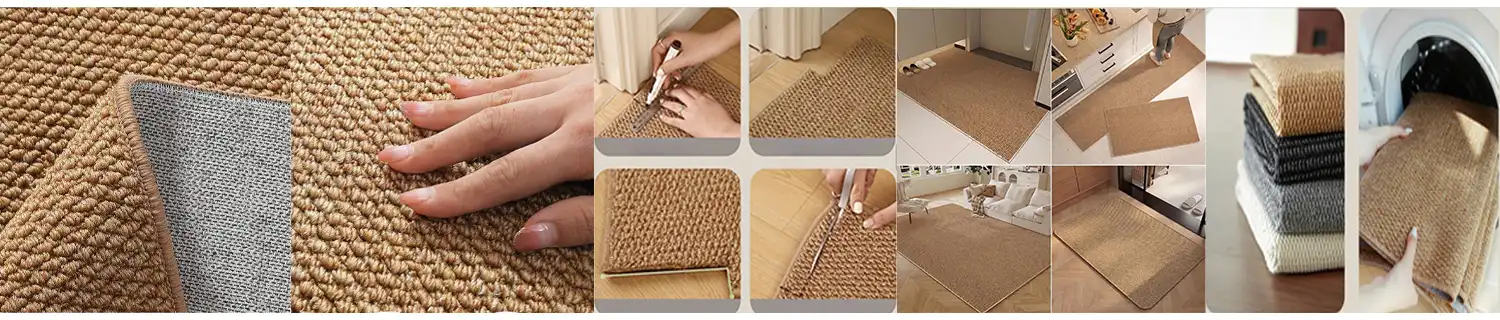
Understanding Sisal Mats: Natural vs Imitation
The agave sisalana plant is where natural sisal comes from. It is mostly harvested in Brazil, Tanzania, and Kenya. The fibers are spun and woven into mats with rough, bumpy surfaces that are valued for their natural look. This old-fashioned method makes a product that has real charm, but it has some problems, like a rough texture, a tendency to become damaged by water, and color loss when exposed to UV light.
Raw Material Differences
Natural sisal fibers are biodegradable and absorb water because they are made of cellulose and lignin. They take in water from the air, which makes places where mold and mildew can grow. Synthetic sisal floor covers, on the other hand, are made from extruded polyester or polypropylene strands that don't let water stick to them at all. When moisture absorption rates drop below 0.05%, bacteria can't grow and the product lasts a lot longer.
Manufacturing Innovation
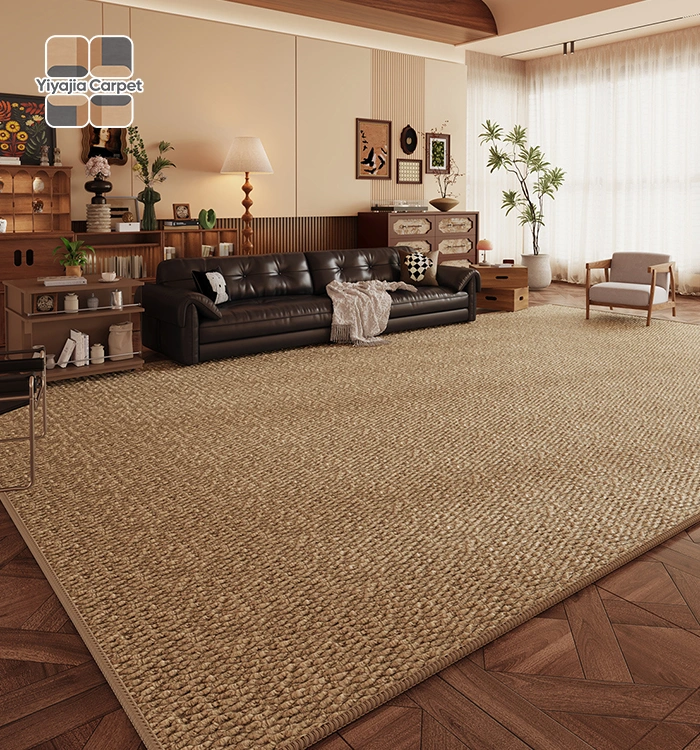
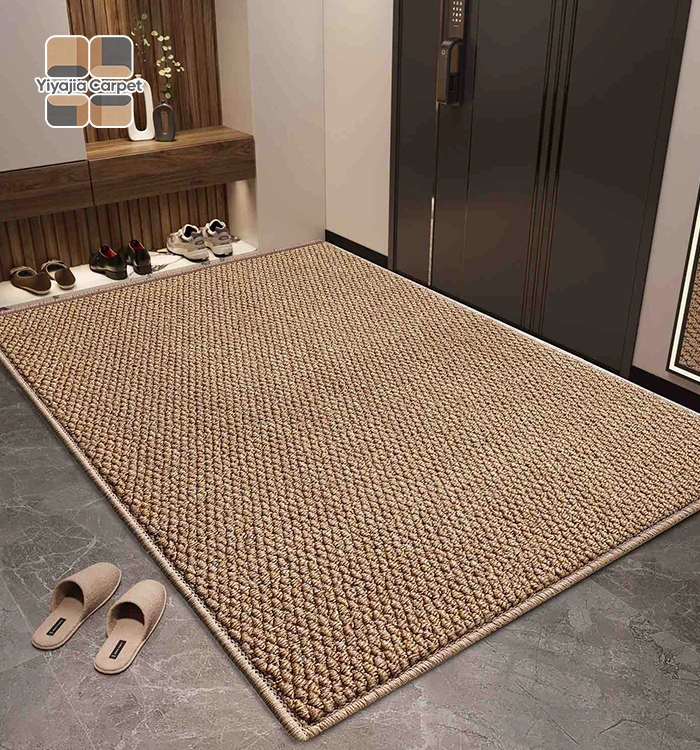
Modern imitations use more complex weaving methods to copy the herringbone, bouclé, and tiger-eye patterns found in real items. The factory where Yiyajia Carpet is made uses high-density tufted construction with 0.6 cm lock stitch accuracy to make the carpet look real and add TPR backing to make it non-slip. Heat transfer printing lets you change any pattern, which is great for boutique stores that need unique designs, like beige and gray or choices that are dyed to match specific room colors.
Environmental Considerations
Even though natural fibers seem good for the environment, they need a lot of water and pesticides to grow. When approved under OEKO-TEX and REACH standards, synthetic options make sure chemicals are safe and can be recycled. ISO 9001-certified factories like Yiyajia Carpet use quality controls to reduce waste and energy use during production. This helps European and North American markets deal with sustainability issues.
Comparative Performance Analysis: Durability, Maintenance, and Functionality
Performance metrics show why synthetic alternatives are becoming more and more popular in both business and home settings. This testing information shows real benefits that lead to a lower total cost of ownership.
Durability Under Traffic
In commercial settings with a lot of foot traffic, natural sisal starts to show signs of wear after 6 to 12 months. Fibers get flattened, frayed, and leave bare spots in places where people walk a lot. Synthetic choices are better at resisting wear and tear; they meet ASTM D3884 standards and don't pill or fuzzy up much after thousands of turns in Taber Abrasion tests. The high-density structure—which is usually 1200 g/m² at 9–15 mm thickness—keeps its look for a lot longer than plant-based fibers.
Moisture and Stain Resistance
Because natural sisal is oleophilic, spills of oily substances like coffee, wine, or pet urine soak in right away and leave lasting stains. Without skilled drainage, cleaning is almost impossible. Imitation Sisal Mat offers a practical alternative: synthetic sisal floor mats have surfaces that don't absorb water, so spills don't soak in. Most dirt and grime can be removed with a quick wipe of light soap. This feature is very useful in places like hotel lobbies, restaurant foyers, and home mudrooms where the surface is always wet.
UV Stability and Color Retention
Natural fibers break down quickly in direct sunlight, making them weak and changing color within one season outside. Solution-dyed synthetic yarns have UV stabilizers that meet ISO 105-B02 standards and get scores of 7-8 on the Blue Scale. This means that it can be exposed to more than 3,000 hours of sun without fading much, which is important for sunrooms, patios, and business spaces with floor-to-ceiling windows.
Maintenance Requirements
To keep the fibers from getting damaged, natural sisal needs to be vacuumed regularly on low settings, spills need to be blotted right away, and it needs to be professionally cleaned every 6 to 12 months. Synthetic options can handle regular vacuum cleaners, cleaning spots with household items, and even low-pressure power washing. Streamlining maintenance instructions to "vacuum weekly, wipe as needed" makes customers happier, according to retailers. This is the kind of message that gets people to buy at the point of sale.
Applications and Use Cases: Selecting the Right Mat for Your Needs
Products that solve specific customer problems are kept in stock by B2B buyers. Figuring out the context of a program helps match features to places where speed is most important.
Commercial Hospitality Environments
The floors in hotel pool decks, spa reception areas, and resort patios are constantly being walked on while they are wet. In nature, sisal would break down in a few weeks. Synthetic options do well in these situations. The TPR backing makes them non-slip, which meets safety standards, and the waterproof structure keeps them from coming apart. Because it dries quickly (moisture evaporates in hours), surfaces stay safe and clean between guests.
Residential Indoor-Outdoor Transitions
People want their living rooms, outdoor patios, and three-season rooms to all have the same look. Because it can handle changes in temperature and humidity, synthetic sisal is perfect for these transitional zones. Custom sizes allow for odd layouts, and the fact that it can be folded up and cut to fit makes it easy to install yourself around furniture and architectural features. Stores that offer this option get sales from design-conscious customers who used to buy less attractive outdoor rugs.
High-Traffic Retail and Office Spaces
Commercial spaces need floor covers that look good even though thousands of people walk on them every day. The non-scratch surface can handle not only people walking on it, but also cart wheels, moving furniture, and pet claws in offices that allow pets. The 0–1 mm pile height keeps people from tripping, and the high-density construction traps dirt particles so they don't spread to other floors. Facility managers like that manufactured products don't need to be replaced as often because they usually last 5 years or more, while natural goods only last 1-2 years.
Specialty Pet-Friendly Applications
Cat owners are a small but loyal group of customers. Cats like to scratch on natural sisal, but it shreds easily, making a mess, and needs to be replaced often. Imitation Sisal Mat provides a durable solution: the textured surface of synthetic sisal is what cats like, and it doesn't tear or fray easily. The washable TPR backing lets owners keep their mats clean without having to buy new ones every time. This solves a problem that leads to good reviews and word-of-mouth recommendations.
Market Overview and Procurement Insights for B2B Buyers
When making sourcing choices, it's not just about the features of the product; pricing systems, order freedom, and seller reliability all play a role in determining how profitable and efficient the business is.
Pricing Benchmarks and Cost Analysis
Most natural sisal mats cost $15 to $35 per square meter at retail, but they can be bought in bulk for $8 to 18 per square meter, depending on how complicated the weave is. Synthetic options cost between $12 and $28 per square meter at stores and between $6 and $15 per square meter in bulk. At first glance, the changes in costs may not seem that big, but lifecycle economics strongly support synthetics. The total cost of ownership shifts decisively toward synthetic choices because natural goods need to be replaced two to three times more often.
Bulk Order Advantages
When manufacturers offer flexible minimum order quantities (MOQ), boutique retailers can try out different styles without having to spend a lot of money. Yiyajia Carpet's method lets small orders of mixed styles start, which works with the small-batch, multi-SKU plan that independent home shops like. This is very different from commodity sellers' strict MOQ rules, which say that buyers must commit to single styles in container numbers.
Supplier Selection Criteria
Verification of certification is what separates professional producers from trading businesses that sell generic goods. OEKO-TEX approval ensures that textiles are safe and chemicals are used correctly, while CE marking proves that goods can be sold in the EU. Getting ISO 9001 certification means that your quality control systems are uniform. REACH compliance shows that chemicals are being used in line with European rules, and EN 13501 flame retardancy ratings meet the needs of commercial installations as set out in building codes. Buyers should ask for up-to-date certificates and check registration numbers directly with the organizations that issued them.
OEM and Customization Capabilities
Heat transfer printing technology lets you put logos on things, make unique patterns, and use brand colors without having to buy a certain number of items at a time, which is what most coloring methods require. Laser cutting makes irregular forms and unique sizes with great accuracy, meeting the needs of business projects' architects. Manufacturers with these skills can make products that rivals can't easily copy, which is good for retailers that want to stand out through unique designs.
Logistics and Lead Time Considerations
Export-standard packaging in rolls, cartons, or woven bags increases the rate at which containers are loaded, which lowers the cost of shipping each unit. Professional freight planning and paperwork help customs clearance go smoothly, which lowers the risk of being held up at the port. Lead times from acceptance of a sample to loading of a container are usually three to four weeks for first orders. Once color standards and specifications are set, lead times for repeat orders drop to two to three weeks. This level of consistency helps with planning yearly buying cycles and sales.
Making the Final Decision: Which Sisal Mat Is Best for Your Business?
A decision framework has to find a balance between many things, such as how something looks, how well it works, how much it costs, and how much it cares about the environment.
Aesthetic Authenticity vs. Practical Performance
When it comes to organic realism, natural sisal can't be beat for customers who care about sustainability messages and natural materials. However, this realism comes with practical problems that cause customer service problems, such as staining reports, premature wear, and damage from water. Imitation Sisal Mat bridges this gap effectively: most stores see the trade-off between synthetic alternatives and natural ones as a good one for business, because synthetic alternatives have 90% of the visual appeal while eliminating 95% of the maintenance problems.
Cost Efficiency Across Product Lifecycle
Short-term buying decisions are based on the initial bulk cost, but smart buyers also look at how often items need to be replaced and how often customers return items. When products last 5 years instead of 18 months, they completely change how to figure out inventory turnover and customer satisfaction. Lower return rates also make it easier to run the business and keep profit margins high.
Safety and Compliance Requirements
Ratings for flame resistance and slip resistance that natural goods can't meet are often needed for commercial projects. Synthetic options that meet EN 13501 standards open up new market opportunities in places like hospitals, hotels, and public buildings where natural fibers are limited by rules.
Customization and Market Differentiation
Instead of price, boutique stores compete on how unique their items are. Color customization, logo integration, and non-standard sizing are all competing benefits that generic goods can't match. Being able to offer unique designs helps build brand identity and supports higher prices.
The synthetic-natural comparison comes down to the types of people who are being targeted. Some high-end sustainable lifestyle brands may choose natural products even though they have some problems, and they may be okay with paying more for product support as part of their positioning. Retailers and business specifiers who focus on volume always choose fake performance because it leads to higher profits through happy customers and efficient operations.
Conclusion
There are clear differences in performance between natural and synthetic sisal that are used every day in both business and household settings. Natural fibers have an authentically organic look, but they are hard to keep up and don't last very long, which is a problem for both sellers and end users. Modern imitations look real and have useful properties like not staining, being waterproof, being stable in UV light, and lasting longer.
These benefits directly lead to fewer customer complaints, lower replacement costs, and better happiness scores for buying managers at small home stores. Imitation Sisal Mat exemplifies this advantage: the final choice is based on the needs and profiles of the customers, but performance data always points toward synthetic solutions when longevity and ease of upkeep are important factors in buying decisions.
FAQ
What makes synthetic sisal softer than natural sisal?
Lignin in natural sisal fibers makes them stiff and tough, which is why they are often described as scratchy or painful to walk on. Texturized polypropylene or polyester filaments are used in synthetic versions to make them flexible and soft to the touch. The way the material is made lets the makers precisely control the fiber diameter and surface texture. The end result is a material that looks like sisal but feels much softer against the skin.
Can imitation sisal mats handle outdoor weather exposure?
Synthetic sisal mats that are made with UV protectors work well in sunrooms and covered outdoor places. They don't fade in direct sunlight for three to five years, which is much longer than natural sisal's one-season life outside. Because it is waterproof and dries quickly, it can be left out in the rain without mold growing. However, the best performance happens in places that are partially or fully covered, not in places that are fully exposed to extreme temperature changes.
Do these mats generate static electricity issues?
In the past, some synthetic floor covers had problems with static electricity. But now, professional-grade goods have constant anti-static treatments that are added when the fibers are extruded. With these methods, the static voltage stays below 2kV, which is a lot lower than what would be uncomfortable. When buying for business uses where sensitive electronic equipment is a worry, buyers should check for anti-static features.
How does cleaning compare between natural and synthetic options?
Natural sisal needs to be cleaned right away if it gets spilled on, vacuumed gently with low suction, and sometimes professionally extracted. Synthetic replacements can be cleaned with normal vacuum cleaners, regular detergents for spot cleaning, and even low-pressure power washing for full cleaning. This ease of maintenance cuts down on customer complaints and support calls, which makes customers happier overall.
Partner With Yiyajia Carpet for Reliable Imitation Sisal Mat Supply
If you are a retailer looking for a reliable Imitation Sisal Mat maker, Yiyajia Carpet can help. They can solve the problems that small home shops have. Our 2,000 m² production plant has been certified by CE, OEKO-TEX, ISO 9001, REACH, and EN 13501, as well as 20 years of experience making things. This makes sure that we meet the standards for both European and North American markets. We accept small orders and have variable minimum order quantities, which lets you use different types of inventory tactics without having to spend too much money.
Custom designs, logos, and odd sizes can be made with heat transfer printing and laser cutting, which sets your products apart from mass-market rivals. You can email our purchasing team at sale@yyj-carpet.com to talk about your specific needs, get sample books that show off our natural color palettes, or look into OEM partnership opportunities. You can find full product specifications and certification paperwork at yyj-carpet.com.
References
1. Floor Covering Weekly. (2022). "Synthetic Fiber Advances in Sisal-Look Products." Floor Covering Weekly.
2. Textile World. (2023). "UV Resistance in Solution-Dyed Polypropylene Flooring." Textile World Magazine.
3. Floor Focus Magazine. (2023). "Total Cost of Ownership Analysis for Commercial Floor Coverings." Floor Focus.
4. International Textile Manufacturers Federation. (2022). "Sustainability in Synthetic vs. Natural Fiber Production." ITMF Annual Report.
5. Journal of Interior Design. (2023). "Material Selection for High-Traffic Commercial Environments." Journal of Interior Design, Vol. 48, Issue 2.
6. Building Standards Institute. (2022). "Flame Retardancy and Slip Resistance Requirements for Commercial Flooring." BSI Technical Standards