_1774494554973.webp)
How do I choose stair floor mats for busy commercial buildings today?
September 23, 2026


Choosing the right stair floor mats for busy commercial buildings requires evaluating several non-negotiable factors: slip resistance performance under both wet and dry conditions, backing adhesion strength, dimensional precision, edge stability, durability under sustained foot traffic, and ease of cleaning. A well-chosen stair tread covering reduces fall-related incidents, protects substrate surfaces, and supports compliance with safety regulations.
According to the National Floor Safety Institute, slip-and-fall accidents account for over one million emergency room visits annually in the United States — making the selection of quality stair coverings a genuine operational priority, not just an aesthetic decision.
Understanding the Core Needs of Busy Commercial Buildings for Stair Coverings
When compared to residential stairs, commercial stairs are put under a different kind of stress. Every day, thousands of people walk up and down stairs in office buildings, hotels, shops, and convention halls. This constant pressure quickly breaks down standard mats, causing fibers to collapse, edges to curl, and, most importantly, less friction.
Managing moisture is a huge issue that goes beyond wear. People often bring wet shoes into hallways and entryways, which then land on stairs. If you don't have a stair floor mats that is made to soak up and dry quickly after being wet, you could slip and fall on smooth tile or wooden steps. The American Journal of Preventive Medicine released research that proves that changes to the surroundings, like putting down non-slip floor coverings, can significantly lower injuries caused by falls in public places.
Noise reduction is another benefit that isn't given enough credit. Dense stair floor mats can cut impact sound transfer by 20 to 30 decibels, which makes business buildings with multiple floors much more quiet.
Critical Criteria to Evaluate When Choosing Stair Tread Mats
In business settings, not all non-slip mats work the same. To avoid making mistakes that cost a lot of money, procurement managers need a structured review system. When it comes to efficiency, these are the main things that separate good items from truly reliable ones:
- Slip Resistance Coefficient: Performance mats must have a Static Coefficient of Friction (SCOF) of 0.6 or more, according to ASTM D2047 rules. Products that meet this standard can be trusted to be safe in both dry and wet circumstances, and this requirement applies equally to stair floor mats, where the risk of slipping is even higher due to angled foot placement and frequent foot traffic.
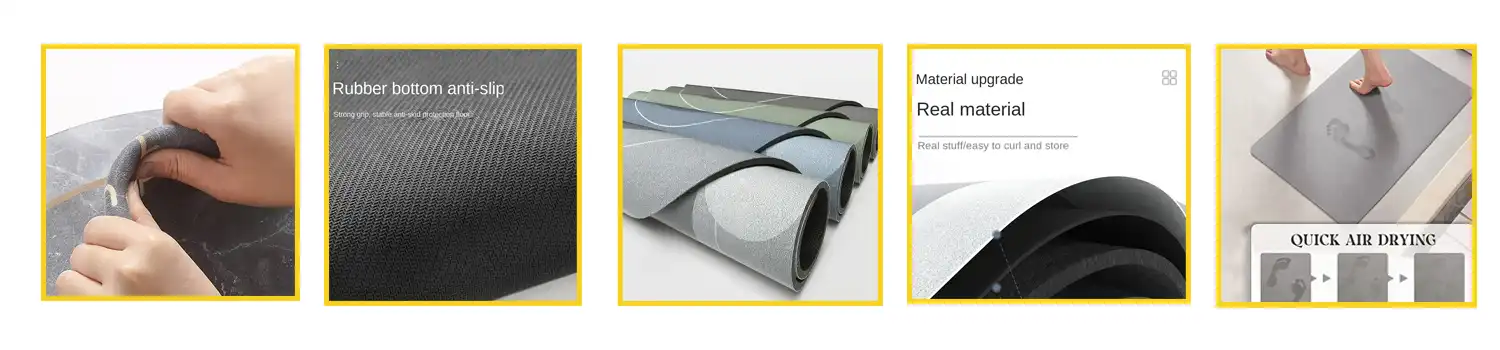
- Backing Adhesion and Material: Natural rubber or thermoplastic rubber (TPR) backings stick to stair steps through surface tension instead of chemical adhesives, so they don't leave any marks on tile or wooden floors. A weight of 1600g/m² means that the material is really dense, not just light padding that moves around when it's loaded.
- Edge Integrity: Laser-cut edges will not fray or curl and will stay the same size. Raised edges create extra trip hazards, which is the main reason why commercial facilities get liability claims for mat-related injuries.
- Dimensional Accuracy: The standard width of step treads in business buildings is between 36 and 48 inches. Mats must perfectly match the tread depth and width; any gaps or overhangs are unsafe and look bad.
- Surface Treatment: Surface treatments that are resistant to stains and easy to clean cut down on upkeep time by a huge amount. When skilled cleaners aren't working, it costs money for businesses like hotels and stores.
Together, these factors make up a solid basis for screening. By consistently using them, you can avoid the common buying mistake of putting price over performance, which is a trade-off that rarely pays off when you factor in the costs of responsibility and replacement.
Comparing Stair Mat Solutions Available in the Market Today
Rubber-Backed Fabric Mats vs. Solid Rubber Mats
Fabric mats with a rubber backing, especially those with high-density technological velvet or diatom mud composite surfaces, are better at absorbing wetness and look softer, making them perfect for hotels, businesses, and mixed-use spaces that combine residential and commercial areas. Solid rubber mats, on the other hand, work best in outdoor and industrial settings where chemical protection and drainage are more important than how they look.
Diatom Mud Surface Technology
Diatom mud is naturally porous and can soak up up to 150% of its own weight in water. It quickly evaporates to release the water. When put on top of stair floor mats, it keeps the tread area dry as soon as it comes into touch with it. Because of this performance trait, it works especially well at building doors and lobby stairs, where a lot of wet foot traffic happens.
Weight and Density as Quality Indicators
When you combine a mat weight of 1600g/m² with a high-density velvet fabric structure, you get real pile compaction. This depth keeps the friction surface from wearing down over years of use, which is a big plus over lighter mats that fall apart in months in business settings with a lot of foot traffic.
Tailoring Stair Mat Selection to Specific Commercial Use Cases
Hotels and Hospitality Venues
In hospitality settings, mats need to be both safe and nice to look at. Custom-printed patterns, solid color schemes, and choices with logos allow hotel brands to make sure that all of their stairways look the same while still meeting fire safety standards like EN 13501. The risk of tripping is low with a 3mm thickness, and it provides good padding.
Office Buildings and Retail Stores
Stair floor mats in stores and offices need to be able to handle a lot of foot traffic without showing signs of wear. Daily use doesn't change the way the surface looks, and quick-dry performance makes sure that cleaning cycles in the morning don't leave surfaces damp for the first people who move in. In these conditions, rubber-backed mats with precisely laser-cut sides work well.
Aged Care Facilities and Assisted Living
For this use case, you need to pay extra attention to visual contrast at the bottom of the stairs, low pile height to support the stability of walkers and canes, and impact absorption in case someone falls. A structure made of high-density cloth and a hard rubber backing meets all three needs at the same time without putting edges at risk of curling.
The right mat definition changes in a useful way. It is not an extra step to make sure that the properties of a product are right for each setting; it is what makes the difference between a product that works and one that causes new risks—and this distinction is especially critical when selecting stair floor mats, where surface angle, edge grip, and drainage needs demand far more scrutiny than flat-floor applications.
How to Procure Stair Floor Mats Effectively for Your Business
Supplier qualification is the first step in reliable procurement. It is best to look for stair floor mats suppliers that have widely known certifications, such as CE, OEKO-TEX, ISO 9001, and REACH compliance. These certifications make sure that the products are safe and that the quality of the production is consistent. For commercial egress routes, EN 13501 flame retardancy certification is a must.
Budgets for purchases are kept safe by evaluating samples before committing to large orders. You should get samples in person and test them on the surface of your stairs. Hardwood, tile, and concrete all react differently to rubber backings. Check how well the SCOF works, how stable the edges are after being bent over and over, and how the surface looks after a simulated wet cleaning.
For brand-aligned business projects, the freedom to customize is important. Genuine procurement flexibility is provided by suppliers who offer OEM and ODM services, heat transfer printing for logos or patterns, and laser cutting for tread sizes that aren't standard. Unit transportation costs for large orders are lower when the minimum order quantity is flexible and export-grade packaging is used to load containers most efficiently.
Conclusion
Choosing stair floor mats for business buildings that are very busy can have direct effects on safety, compliance, and money. In the real world, success is based on factors like slip resistance coefficients, backing adhesion, edge stability, material density, and surface treatment. Diatom mud composite mats with a rubber back, a high-density fabric structure, and precise laser cutting can be used in any business stairs setting, from hotel lobbies to nursing homes. Purchasing managers who use structured evaluation criteria and work with certified, quality-checked manufacturers protect both their companies and the people who use their products.
FAQ
Do commercial stair mats genuinely reduce slip-and-fall incidents?
Yes. Slips happen less often on mats that meet ASTM D2047's SCOF standard of 0.6 or higher. The National Floor Safety Institute says that in business settings, slip-and-fall accidents can be cut by more than 30% with the right floor coverings.
How often should stair tread mats be cleaned in high-traffic buildings?
Routine dirt can be removed by cleaning or dry vac every day. If you spill something on diatom mud, all you need is a damp cloth to clean it up. In high-volume settings, a full wash should be done once a month. Cleaning the floor under the mat on a regular basis is an important maintenance task that many places forget to do. Grit that builds up on the floor and the mat backing can damage both.
Can these mats be customized to fit non-standard staircase dimensions?
With laser cutting technology, you can precisely trim to any tread width or depth, even for curved or spiral staircases. Suppliers that offer OEM customization can meet the exact needs of facility managers.
What certifications should I require from a commercial stair mat supplier?
Need to meet CE marking, OEKO-TEX Standard 100, ISO 9001, REACH, and EN 13501 flame retardancy standards for business projects. All of these certificates show that the product is safe, meets chemistry requirements, and works well in fires.
Partner With Yiyajia Carpet for Reliable Commercial Stair Mat Solutions
Yiyajia Carpet sells approved, high-performance stair floor mats that are made to work in tough business settings. Our goods are certified by CE, OEKO-TEX, ISO 9001, and REACH, and every order is inspected before it is shipped. We are a reliable company that makes stair floor mats and can do both OEM and ODM work. We can make mats in any size, pattern, or with your logo on them, and we can send you a sample in 24 to 48 hours. To get samples and bulk pricing right away, email our purchasing team at sale@yyj-carpet.com or visit yyj-carpet.com.
References
1. National Floor Safety Institute. Slip and Fall Quick Facts. NFSI, 2022.
2. American Journal of Preventive Medicine. Environmental Interventions to Reduce Fall-Related Injuries in Public Buildings. Elsevier, 2021.
3. ASTM International. ASTM D2047: Standard Test Method for Static Coefficient of Friction of Polish-Coated Flooring Surfaces. ASTM, 2019.
4. European Committee for Standardization. EN 13501-1: Fire Classification of Construction Products and Building Elements. CEN, 2018.
5. Occupational Safety and Health Administration. OSHA Walking-Working Surfaces Standard (29 CFR 1910 Subpart D). U.S. Department of Labor, 2017.
6. OEKO-TEX Association. OEKO-TEX Standard 100: Testing for Harmful Substances in Textiles. OEKO-TEX, 2023.