_1774494554973.webp)
Which Anti-Slip Bottom Is Safest for a Crystal Velvet Utility Door Mat?
October 9, 2026


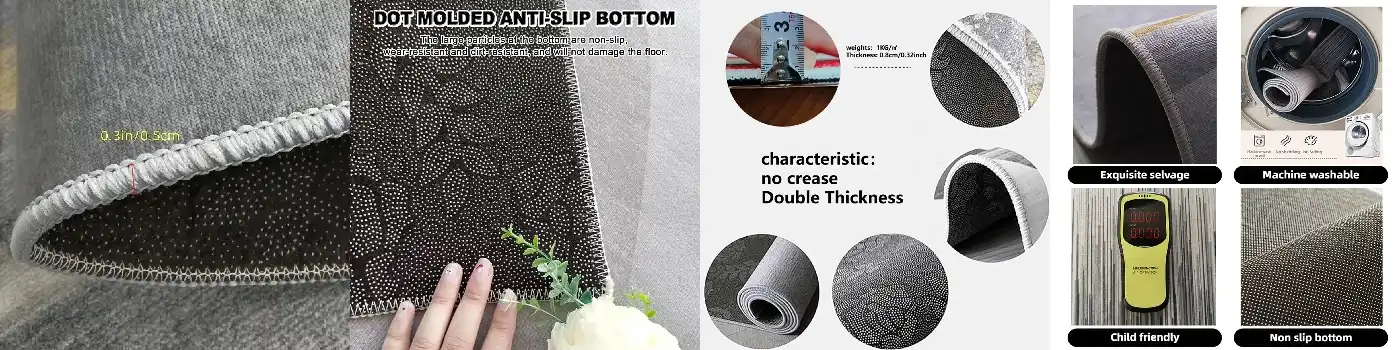
When sourcing a crystal velvet utility door mat at scale, the backing material is not a secondary detail — it is a core safety and liability variable. TPR (thermoplastic rubber) consistently ranks as the safest anti-slip bottom for this mat type. It bonds effectively with smooth, tile, hardwood, and laminate floors without staining, resists moisture-induced degradation, and maintains traction under wet or snowy conditions. Unlike PVC, which becomes brittle in cold climates, TPR retains flexibility across a wide temperature range, making it the preferred choice for high-traffic residential and light commercial entry zones.
Understanding Anti-Slip Bottoms for Crystal Velvet Utility Door Mats
The bottom layer of an entrance mat directly controls how that mat acts when it is walked on, gets wet, or touches the floor. When it comes to crystal velvet mats, where the surface pile is soft, dense, and fairly thick, the non-slip bottom has to account for the mat's natural tendency to move when weight is put on it at an angle.
Common Backing Materials and Their Properties
The market is mostly made up of three materials: natural or synthetic rubber, PVC, and latex. Each one has a different effect on the smooth surface above it.
- TPR (Thermoplastic Rubber): Flexible, doesn't smell, and is chemically stable. TPR doesn't give off any dangerous chemicals, which is why it is often used as the usual backing for CE and ROHS-certified mats. Even after months of use, it doesn't leave any dust on hard floors where it's used.
- PVC: Cheap and easy to find, but it tends to harden in temperatures below zero. When it freezes and thaws in North America, PVC-backed mats can curl at the edges, which is known to be a trip hazard that makes slip-and-fall liability higher.
- Natural Latex: Natural latex has a good grip at first, but it breaks down when it comes in contact with water, UV light, and harsh cleaners for a long time. The time between replacements is shorter, which raises the total cost of acquisition over time.
Before making bulk orders, procurement managers can make sure that the backing pick fits with their deployment environment when they understand these differences, utility door mat being a prime example of how specific backing types affect real-world performance.
Key Factors When Selecting the Safest Anti-Slip Bottom
Choosing the right backing isn't just a matter of material science. It involves looking at four practical aspects: how well it grips the ground, how long it lasts, how well it works with the floor, and how much care it needs.
Traction and Friction Coefficient
As per the National Floor Safety Institute (NFSI), "high traction" means that the static coefficient of friction (SCOF) is at least 0.6 on wet surfaces. If your mat isn't up to this level in the rain or snow, you could be legally responsible. The material on the back of TPR-backed mats always gets NFSI-compliant friction scores because it doesn't get stiff and flat when pressure is put on it.
Durability and Floor Compatibility
When you have to restock dozens of stores every month, backing that lasts a long time is very important. If the backing breaks down within 12 months, you have to reorder it early, which throws off your inventory planning. TPR stays strong even after being wet and dried many times, so it can be used with polished tile, luxury vinyl plank (LVP), and engineered hardwood, which are all popular floor types in North American homes where these utility door mats are offered. It doesn't stain, change color, or react chemically with most floor finishes, so customers are less likely to complain after the sale.
Maintenance Requirements
Mats get dirty quickly in stores with a lot of foot traffic. If the backing bends, peels, or loses its grip after being washed in the washing machine, you'll have to deal with a customer service issue. If the bond between the pile and backing is strengthened during manufacturing, TPR-backed mats can withstand gentle machine cycles or pressure washing without delamination. This is something that should be confirmed with suppliers before finalizing specifications.
Comparing Popular Anti-Slip Backings for Crystal Velvet Utility Door Mats
Not every anti-slip backing works the same way in different environments, with different amounts of traffic, and with different numbers of purchases. You can see a straight review of the best choices for business-to-business buyers below.
- TPR vs. PVC: TPR stays flexible between -20°C and 80°C, which makes it a reliable choice for Northern US and Canadian climates all year long. When it drops below -10°C, PVC becomes stiff, which causes edges to curl and less floor touch. This is exactly when the risk of slipping is highest. TPR is the safer choice for moving large amounts of utility door mat across areas with a mix of climates.
- Rubber-Free Options: Buyers who care about the environment may look into recycled felt or non-woven fabric backings. When used over carpet, these materials don't do too badly, but they don't do at all when used on hard, smooth floors. They could be put in a bedroom or living room, but not on an entry door, where wetness would constantly be tracked in.
- Washable Heavy-Duty Backing: For retail spaces or lobbies that get a lot of foot traffic, a reinforced TPR backing with a textured waffle pattern keeps dirt in and doesn't slip after being washed many times. Because dirt and grit are heavier in hardware stores and home improvement showrooms than in most homes, this construction is especially useful for mats used there.
- Eco-Friendly Alternatives: Buyers who have to meet CSR requirements are becoming more interested in recycled TPR materials. These have friction ratings that are similar to new TPR while using less material. Reputable producers can provide REACH-compliant paperwork proving chemical safety, which is a must for selling in the EU.
These differences can be seen in the total cost of landing, the number of returns, and the image of the brand on the store.
Practical Guidance for B2B Procurement of Crystal Velvet Mats with Safe Anti-Slip Bottoms
Scaled-up purchasing choices need more than just material knowledge; they also need to be based on accurate source verification, certification alignment, and efficient transportation.
Certifications and Safety Standards to Require
At the very least, ask any provider you're considering the following:
- CE and ROHS certification proves that the product meets EU safety rules for chemicals and electricity. This is important for any North American distributor who also sells in Europe.
- ISO 9001—checks that the plant has a written quality control system, which lowers the chance of batch differences.
- REACH compliance documentation confirms that the backing material doesn't have any restricted substances above a certain level.
- ASTM D7570 dimensional stability report shows that the utility door mat will not ripple or shrink when the temperature changes, which could cause someone to trip.
Customization and MOQ Considerations
When it comes to running a business, being able to choose the size, color, and backing of multiple SKUs across different store layouts is very helpful. If a seller has a MOQ of 50 pieces per size or color variation, you can try out different combinations without having to commit to full pallet quantities.
Hallway mat options can be included in these flexible trial orders, allowing you to test durability and foot-traffic performance in real store conditions. Private-label projects can be supported by logo customization that can be done in 7 days without slowing seasonal replenishment processes. Having these skills lowers the risk of buying something during the initial phase of qualifying suppliers.
Installation, Usage, and Maintenance Best Practices to Maximize Safety
When installation or upkeep instructions aren't followed, even the best backing doesn't work as well as it should.
Proper Surface Preparation and Positioning
The floor must be clean, dry, and free of wax buildup or cleaning agent dust before you put down any entry mat. These things lower the coefficient of friction between the backing and the floor, which means that no matter what kind of material the mat is, it won't keep you from slipping. Place the mat so that it is flush with the door threshold. Make sure that the transition strips don't overlap with the mat, as this will make the surface below it uneven.
It's also important to stick to a repair plan. Check the quality of the backing every six months for normal home use or every three months for business use. The waffle pattern may become flatter, the edges may curl, or there may be a clear split between the pile and backing. Early spotting stops liability incidents and helps with planning reorders on time, which is a useful safety measure for procurement teams that are in charge of big store networks.
Conclusion
When it comes to safety, TPR is the best non-slip bottom for a crystal velvet utility door mat. It has good grip in both dry and wet circumstances, doesn't break down when the temperature changes, and meets all major international safety standards. If a procurement worker is buying a lot of entry mats, choosing TPR-backed, CE/ROHS-certified goods lowers their liability, lowers the number of returns, and keeps the supply chain stable. This specification is confirmed by supplier certifications and pre-shipment inspections. This makes sure that the safety performance advertised in the catalog is the safety performance that is delivered to the shelf.
FAQ
Does the non-slip material on the back of the Crystal Velvet mat change how it works compared to other surfaces?
Yes. Woven polypropylene mats have less surface mass than crystal velvet pile mats. This means that the backing must create enough floor friction to balance out the mat's greater inertia. This is something that TPR does better than PVC or rubber on most hard floors, especially tile and LVP.
How often should anti-slip backing be checked in business settings?
In areas with a lot of foot activity, check the soundness of the backing every three to six months. Check for texture loss, edge separation, and any floor stains that come from the backing wearing down. An inspection period of six to twelve months can be used for residential operations.
Are backings that are good for the environment a safe option to rubber?
In lab tests of friction, recycled TPR compounds work about the same as new TPR. They can be used instead if they come with proof that they are compliant with REACH. Avoid "eco" backings that aren't labeled and don't have third-party test reports because performance isn't always the same for every utility door mat from one manufacturer to the next.
Can TPR-backed mats be moved over long distances without getting bent?
When mats are packed correctly—either flat in cartons or rolled with enough core support—TPR keeps its shape even when it's being compressed during ocean freight. Before confirming the shipping format for big orders, ask the maker for their packing specs.
Partner with Yiyajia Carpet for Reliable Utility Door Mat Supply
Yiyajia Carpet offers a certified crystal velvet utility door mat supplier program built for distributors who need consistent quality, competitive FOB pricing, and flexible customization. Our mats feature fine faux cashmere surfaces, TPR thermoplastic rubber backing, CE/ROHS certification, and machine-woven edge locking — ready to scale from 50-piece sample runs to full container orders. Contact our team at sale@yyj-carpet.com or visit yyj-carpet.com to request samples and wholesale pricing.
References
1. National Floor Safety Institute (NFSI). NFSI B101.1: Test Method for Measuring Wet SCOF of Common Hard-Surface Floor Materials. NFSI, 2012.
2. ASTM International. ASTM D7570: Standard Guide for Determination of Various Characteristics of Matting. ASTM International, 2018.
3. European Chemicals Agency (ECHA). REACH Regulation (EC) No 1907/2006: Understanding REACH. ECHA, 2021.
4. Chang, L., & Matz, S. "Slip Resistance and Surface Friction of Floor Coverings Under Wet Conditions." Journal of Safety Research, Vol. 48, 2014.
5. Textile World. Performance Benchmarks for Thermoplastic Rubber Backings in Commercial Flooring Applications. Textile World, 2020.
6. International Organization for Standardization. ISO 9001:2015 Quality Management Systems — Requirements. ISO, 2015.