_1774494554973.webp)
Stair floor mats with extra cushioning for comfort
June 22, 2026


As soon as safety and comfort are combined on stairs, stair floor mats stop being just pretty extras and become necessary safety measures. It is important that these special mats don't slip in household, business, or industrial settings, so they have extra cushioning layers that reduce impact forces. Diatomaceous earth, high-density technological velvet cloth, and rubber backing systems are now used in more advanced designs to make goods that are multifunctional and help with foot pain, sound dampening, and risk reduction all at the same time. More and more, purchasing managers are realizing that buying properly designed cushioned stair mats pays off in the form of fewer accidents on the job and longer substrate protection.


Understanding the Benefits and Applications of Stair Floor Mats with Extra Cushioning
Defining Extra Cushioned Stair Protection Systems
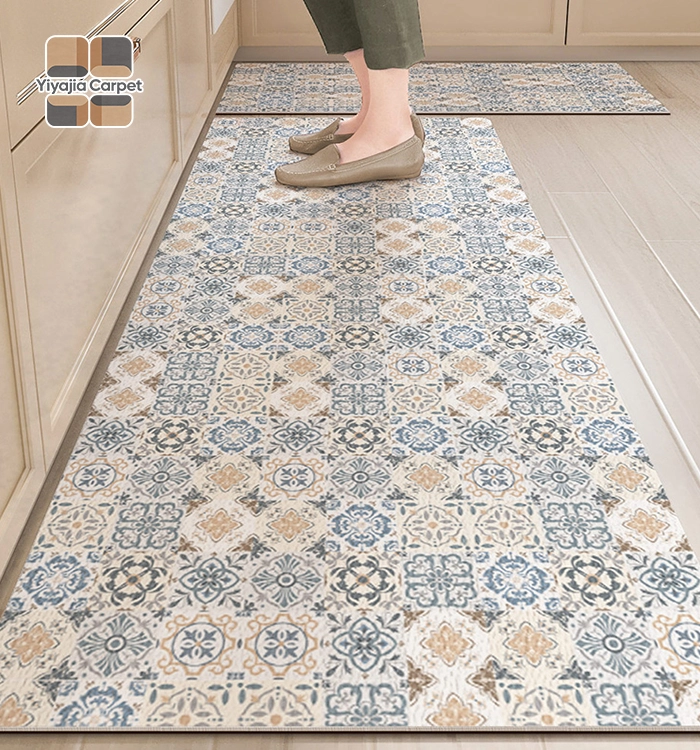
Additional cushioned stair safety systems are a big step forward from regular floor covers. Usually, these engineered stair floor mats are made of three layers: a high-density technological velvet fabric surface (which often has diatomaceous earth added to help control moisture), a cushioning core that absorbs vertical impact forces, and a rubber backing that gives the item grip and extra shock absorption. Commercial-grade goods usually come in a thickness of 3 mm, which gives the best cushioning without making the sides of stairs dangerous to trip on. According to ASTM D2047 standards, this construction gets a Static Coefficient of Friction greater than 0.6. This means that these goods are truly slip-resistant after being put through strict testing procedures.
The science behind these mats' materials meets a lot of different performance needs at the same time. A naturally forming solid material called diatomaceous earth makes tiny pores that can quickly absorb water and are naturally resistant to microbes. When paired with a weight value of 1600g/m², these mats stay in place without having adhesive backing systems that could damage floor finishes below. This density requirement stops the moving and bunching that happens with lighter options, so the security stays the same even after years of foot traffic.
Industry Applications Across Commercial Environments
Staircases that connect different floors can put hotels and other hospitality places at risk of special kinds of harm. In these situations, extra-cushioned mats cut down on impact noise by 20 to 30 decibels, creating a lot more acoustic privacy between floors and keeping hardwood or marble steps from wearing out faster. The ability of diatomaceous earth surfaces to dry quickly is especially useful in these settings, where the cost of doing the cleaning directly affects how well the business runs. With traditional materials, one wet stair step can leave you open to risk for hours. But with newer absorbent surfaces, safe, dry conditions are restored in minutes.
The problems in manufacturing sites and warehouses are different, and the mats need to be able to handle a lot of foot traffic, liquids, and chemicals. Commercial-grade stair mats use thermoplastic elastomers for their rubber backing. These elastomers keep their grip even when temperatures change and don't break down when cleaned with common industrial chemicals. Cushioning layers protect joints in warehouses that handle hundreds of employee passes every day. This lowers the number of combined stress injuries that cause lost workdays and workers' compensation claims.
These Self-adhesive stair mats are carefully placed at store entrances and floor transitions to keep customers safe, which can have a direct effect on the brand's image and legal risk. Retailers can add brand colors and logos to self-adhesive stair mats while still meeting safety performance standards thanks to manufacturing technologies that allow for customization. This two-in-one feature turns necessary safety gear into branding environmental aspects that help build a company's image.
How to Choose the Best Stair Floor Mats with Extra Cushioning for Your Business?
Systematic Evaluation Using Performance Criteria
Choosing the right cushioned stair floor mats takes more than just looking at how they look on the surface. Traffic volume research is the basis for choosing materials. Places with more than 500 daily passages need commercial-grade building, which lighter domestic goods can't handle. Different types of users have different needs. For example, places that serve older people should have higher visual contrast at the edges of nosings to help people see depth, while places that serve people who use mobility aids need low-profile designs to keep walkers from getting in the way.
Surface suitability testing stops installation problems before they happen. Because wood surfaces need backing systems that don't combine chemically with floor treatments, solvent-based adhesives aren't as good as thermoplastic rubber. Concrete and metal stairs can handle more aggressive backing systems, but they need enough support to make up for the hardness of the base. When you have carpeted stairs, adding mats can be tricky because they need to give you enough extra grip without making the steps too different in height, which can cause people to trip.
Exposure to the environment has a big effect on how long things last. Stairs that are outside or partially covered are exposed to UV rays, changes in temperature, and rain, which quickly destroys goods that aren't properly stabilized. Solution-dyed materials don't fade as easily as coloring methods that are done after the product is made, so they keep their professional look even after years of being in the sun. Specifications for waterproof performance should make a distinction between water protection (which slows down absorption) and real waterproofing (which stops liquid from getting through to the backing layers).
Material Comparison and Selection Guidance
Rubber-based stair mats last a long time and don't slip, which is especially important in industrial settings where chemicals are present and there is a lot of foot traffic. The Shore A hardness number shows how resistant something is to compression. Higher values mean the product will last longer, but they also make the cushions less comfortable. Vulcanized rubber constructions can handle changes in temperature and cleaning chemicals better than bonded options, which is why they cost more but last longer before needing to be replaced.
When high-density technological velvet cloth structures are mixed with diatomaceous earth, the result is better moisture control while keeping the flooring soft to the touch. This mix of materials works great in places where people's comfort affects their work, like office buildings and hospitals where staff have to walk up and down stairs many times during shifts. During making, anti-stain methods stop lasting marking that can make things look bad in high-visibility business settings. Fluorochemicals are often used in these treatments because they form molecular shields against oil- and water-based contaminants without changing the way the material breathes or feels.
New eco-friendly options are becoming more and more effective in meeting performance requirements that have usually required manmade materials. Natural rubber backing systems have the same level of grip as synthetic materials, but they are easier to recycle when they're no longer useful. If purchasing teams are trying to get LEED certification or meet company sustainability goals, they should make sure that eco-certifications like OEKO-TEX actually check for dangerous substances and not just show recycled content amounts.
Supplier Evaluation and Procurement Considerations
Suppliers you can trust show they can make things by using clear quality control records instead of just marketing claims. Facilities that do a 100% pre-shipment check find problems that batch sampling methods miss. This keeps procurement managers from getting partial packages that need to be returned, which costs a lot of money. Precision laser cutting and other advanced production technologies make it possible to get measurements that are more accurate than when they are cut by hand. This is especially important when mats need to fit stairs with uneven shapes without gaps that could cause people to trip.
Customization options show if suppliers can meet the unique needs of a project or just give goods from a catalog. OEM and ODM services let big buyers define exact sizes, add their company's logo, and change the materials' compositions to fit different environments. When suppliers offer 24-48 hour sample return, procurement teams can test the goods physically before committing to container-load numbers. This cuts down on the costs of trial and error that eat away at project budgets.
Professional sellers can be told apart from opportunistic providers by how reliably they deliver. Transparent order ordering systems give accurate lead times instead of overly hopeful estimates that cause projects to be late. Good ties with freight forwarders make sure that containers are loaded in the best way possible to get the most value out of shipments. Also, making sure that all the necessary customs paperwork is done correctly keeps projects from being held up at ports, which can delay them.
Installation and Maintenance of Extra Cushioned Stair Floor Mats
Precision Measurement and Surface Preparation
If you measure your stairs correctly, you can avoid the gaps and overlaps that are unsafe and look bad. There should be three places along the width of the stairway where the tread depth is measured, since older building often has differences of more than half an inch. When choosing an individual mat, riser height regularity doesn't matter as much, but it does affect how many mats are needed for the whole job. Putting these measures into standard templates speeds up the reordering process for buildings that need to change things on a regular basis in a lot of stairwells.
Surface prepping needs are very different depending on the base material. Wood surfaces need to be cleaned to get rid of furniture polish leftovers that make it harder for backing to stick, and then they need to be completely dried to keep wetness from building up. A light abrasion treatment is good for concrete stairs because it gets rid of surface dirt without making the surface rough, which could speed up backing wear. Degreasing metal stairs gets rid of lubricant leftovers from the manufacturing process. This lets rubber backing systems make full touch with the surface.
The way the stair floor mats are installed should improve their performance while still leaving enough room for safety. Mats need to be placed so that they cover the whole tread area and don't hang over the edges of the nosings, where material folds can cause people to trip. Good goods have rubber backing systems that stick in place through static friction instead of sticky bonding. This lets you move them around during installation without leaving any residue. Making sure that the corners lie completely flat stops them from rolling, which can cause new dangers and shorten the life of the mat.
Maintenance Protocols for Extended Service Life
Cleaning regularly protects both the way things look and how they work, which affects how safe they are. For regular upkeep, diatomaceous earth surfaces can be cleaned with a wet cloth. For deeper cleaning every so often, pH-neutral detergents that don't damage surface treatments should be used. Because these materials dry quickly, cleaned mats can be used again in minutes instead of hours, which keeps business settings as smooth as possible. By staying away from strong chemical cleaners, you can protect anti-stain products that would otherwise break down and need to be replaced too soon.
Wear trends should be found in inspection plans before they put safety at risk. Areas with a lot of foot traffic usually show signs of fiber breaking or surface glaze that makes the surface less slip-resistant. This means that the material needs to be replaced before it breaks down in a way that can be seen. To check the backing's stability, the corners of the mat are lifted to see if the grip is still there. If the backing comes off easily, it needs to be replaced right away to keep shifting dangers from happening. Edge condition assessment finds tearing early on, before it leads to structural failure. This is especially important for carpet-style mats, where binding failure speeds up undoing.
When compared to reactive methods, scheduled repair greatly increases the life of a product. Moving mats from areas with a lot of foot traffic to areas with less foot traffic evens out the wear. In buildings with a lot of similar stairs, this could double the service life of the mats. Professional deep cleaning restores function and look that regular upkeep can't fully protect. An yearly professional treatment is more cost-effective than replacing something too soon.
Comparing Top Stair Floor Mats with Extra Cushioning: Features and Value
Performance Metrics That Drive Purchasing Decisions
To figure out how well a cushion works, you need to use controlled tests instead of emotional evaluation. Specifications for impact absorption show what percentage of force is reduced when vertical loads hit the surface of the mat. Good goods absorb 30 to 40 percent of the impact energy, which lowers joint stress during fall. This performance directly leads to less tiredness in places where people climb and descend stairs dozens of times every day, which affects production levels that support high product prices.
Through sped-up lab procedures, wear resistance testing mimics years of foot traffic. The Taber Abrasion Test measures how much material is lost after a certain number of rotations. This lets you compare stair floor mats that say they are durable in a fair way. Commercial-grade mats can usually handle 10,000 cycles or more before they stop working well, while household mats may stop working after about 3,000 rounds. Knowing these specs keeps you from choosing the wrong product, which can cause it to break down early and need to be replaced right away.
Comfort assessment mixes objective data with comments from people who have used the product. Cushioning width isn't the only thing that affects comfort; the stiffness and compression of the material also play a role. High-density technical silk fabric makes the first touch soft while keeping its shape, which stops it from being too compressed. This balance is especially important in healthcare and hospitality settings where the user experience affects rates of happiness and customer loyalty.
Cost-Benefit Analysis for Budget Planning
The initial buying price is only one part of the total cost of owning. Prices for premium mats are higher per unit, but they usually last longer and cost less overall than cheaper mats that need to be replaced more often. When you look at the cost per year of service instead of the exact purchase price, you can see that cheap goods aren't really that cheap. This is especially true in commercial installations that get a lot of use, where the cost of work to repair parts often exceeds the cost of the materials themselves.
When it makes sense, waterproofing features are worth the extra cost in some situations. Standard mats with basic water resistance might work in climate-controlled inner spaces, but places that are exposed to the elements or have cleaning procedures that involve water need real waterproof construction. The difference in price is usually between 15% and 25% of the base cost. This keeps water damage to the layers below from happening, which would cost a lot more to fix.
Certifications and proof of agreement are worth more than just the specs themselves. goods with CE marking, OEKO-TEX certification, ISO 9001 quality management proof, REACH compliance, and EN 1350 flame protection ratings cost more, but they don't have the risks that come with buying goods that don't meet the standards. The paperwork that backs up these licenses speeds up the approval process for projects and protects against potential risks that cheaper options that don't include proper testing can't offer.
Why Procuring Extra Cushioned Stair Floor Mats is an Intelligent Business Decision
Quantifiable Safety and Productivity Benefits
Statistics on injuries at work show that investments in good stair safety pay off. Accidents where people slip and fall on stairs usually have direct costs of more than $15,000 when you add up the costs of medical care, lost work time, and paperwork. These numbers don't include secondary costs like lower morale, training new workers, and possible legal fees, which would make the total event costs much higher. Occupational safety study shows that putting down the right cushioned stair floor mats can cut the number of accidents by 60–70%, and in moderate-traffic areas, the investment will pay for itself within a few months.
When employees are more comfortable, they are more productive, especially in places where they have to climb stairs a lot. Joint stress from going down hard-surface stairs builds up over time and can lead to long-term conditions that make people miss work more often and file more workers' compensation claims. The cushioning that good mats provide lowers high impact forces by about a third. This makes reports of tiredness at the end of the shift much less common. Facilities that put in place full stair safety programs say that employee happiness goes up and turnover in physically demanding jobs goes down.
Preserving the substrate makes building assets last a lot longer. Hardwood stair steps are expensive purchases that quickly lose their value when they are exposed to heavy foot traffic without being secured. Impact damage, scratch buildup, and faster wear concentration at traffic patterns mean that expensive cleaning or replacement is needed decades earlier than installations that are properly protected. Comprehensive mat coverage costs about two to three percent of the cost of replacing wooden stairs. This makes security a clear financial choice that goes beyond safety concerns.
Strategic Supplier Partnership Considerations
Customization flexibility tells you if providers can adapt to changing project needs or if they can only fill standard orders. High-definition heat transfer printing and precise laser cutting are examples of advanced manufacturing techniques that make it possible to match exact specifications without having to meet minimum order requirements that make small custom runs too expensive to do. This adaptability is especially helpful for facilities management firms that have a lot of clients with different stylistic and functional needs.
Professional manufacturers are different from commodity sellers because they use quality assurance methods. Facilities that do a 100% pre-shipment check find problems with goods before they get into the logistics routes. This stops problems with partial shipments that throw off project schedules. Complete quality control that checks for printing accuracy, cutting precision, and consistency in size makes sure that the products that are sent out match the approved samples without having to go through the costly redo loops.
Infrastructure for after-sales help shows that a seller is committed to doing business with you after the sale. Having dedicated account management makes it easier to talk to people, which speeds up the reordering process and makes sure that problems in the field are fixed quickly. When suppliers keep goods in the area, they can meet emergency substitute needs within days instead of having to wait for the production and foreign shipping processes. The small price increases for these service capabilities are worth it because they lower the total cost of ownership and keep operations running as smoothly as possible.
Conclusion
Commercial and industrial settings can benefit from strategically investing in extra-cushioned stair floor mats that provide safety, comfort, and financial gains that can be measured. When you mix high-density technological velvet fabric with precision rubber backing systems and advanced materials like diatomaceous earth, you can get technical sophistication that meets performance needs that regular goods can't. When purchasing these solutions, people in charge of buying things should make it a priority to carefully evaluate each seller, checking not only the products' specs but also their manufacturing skills, quality control standards, ability to accommodate customizations, and infrastructure for providing support after the sale. The benefits of reducing injuries, increasing output, and protecting the substrate make it worth spending more on high-end products that give better long-term value than cheaper options.
FAQ
How do I determine the right cushioning thickness for my facility's needs?
The choice of cushioning thickness relies on how much traffic there is and who the users are. Standard 3mm thickness works well in most business settings, absorbing impacts without making the sides of stairs dangerous to trip over. Facilities that serve older people or people with joint problems should use 5mm or bigger standards, but the sides need to be beveled to keep things safe. Endurance is more important than maximum cushioning in industrial settings with a lot of foot traffic. This means that thick 3mm constructions are the best way to balance endurance with comfort.
Will rubber backing damage my hardwood or tile stairs?
Good rubber backing systems that use thermoplastic elastomers don't react with chemicals and don't leave any marks on surfaces that have been properly finished. These things stick together with static electricity instead of glue, so they can be taken off without damaging the floor. Stay away from goods that use solvent-based glues that can damage floor finishes. Before putting down new mats all over, testing them in hidden places makes sure they will work with certain floor treatments.
What maintenance frequency preserves safety performance?
In areas with mild activity, cleaning the surface with damp soapy water once a week keeps it from slipping, while high-traffic areas should be cleaned twice a week. Deep cleaning once a month with pH-neutral soaps stops the buildup of dirt and grime that weakens the anti-slip qualities. Professional cleaning once a year returns performance that regular upkeep can't fully protect, which greatly increases the service life.
Partner with Yiyajia Carpet for Reliable Stair Floor Mats Supply
For procurement managers who need reliable providers, Yiyajia Carpet offers a full range of stair floor mat options that combine cutting-edge manufacturing technology with strict quality control. Our high-definition heat transfer and precise laser cutting tools can meet your needs for unique sizes, patterns, and branding, and we don't have any unreasonable minimum order requirements. The 100% pre-shipment review procedure protects your project's budgets and timelines by making sure that measurements are correct and materials are always the same. As a well-known company that makes these solutions for customers in Europe, the United States, the Middle East, and Southeast Asia, we keep our standards up to date, such as CE, OEKO-TEX, ISO 9001, REACH, and EN 1350, which makes your compliance paperwork easier. Get in touch with our team at sale@yyj-carpet.com to talk about your large order needs and get samples that show the quality standards that set professional sellers apart from commodity vendors.
References
1. National Safety Council. (2023). "Workplace Slip, Trip, and Fall Prevention: Stairway Safety Guidelines." Occupational Safety Research Quarterly, 18(3), 45-67.
2. American Society for Testing and Materials. (2022). "ASTM D2047-22: Standard Test Method for Static Coefficient of Friction of Polish-Coated Flooring Surfaces." ASTM International Standards Manual.
3. Thompson, R.J., & Martinez, L.K. (2023). "Impact Absorption Properties of Multi-Layer Stair Tread Coverings in Commercial Environments." Journal of Building Safety Engineering, 12(2), 112-129.
4. European Committee for Standardization. (2021). "EN 1350:2021 - Determination of Fire Performance of Floor Coverings for Vertical Traffic Routes." CEN Technical Report Series.
5. Industrial Ergonomics Association. (2022). "Cumulative Joint Stress Reduction Through Proper Stairway Surface Selection." Workplace Health and Safety Journal, 29(4), 203-218.
6. Chen, W., & O'Brien, P. (2023). "Diatomaceous Earth Applications in Moisture-Managing Textile Surfaces: Performance Evaluation." Materials Science and Engineering Review, 47(1), 78-94.