_1774494554973.webp)
How to clean and maintain an elastic mesh floor mat
July 14, 2026


To keep their anti-slip and anti-fatigue qualities throughout their useful life, Elastic mesh floor mats need to be cleaned in the same way every time. With their open-grid design and elastic polymer structure, these mats keep dirt below the stepping surface while also letting more water drain away. Regular care keeps safety standards in the workplace up to date, stops floors from wearing out too quickly, and protects the big investment people make when they buy good flooring for businesses.
Understanding Elastic Mesh Floor Mats and Their Maintenance Needs
Elastic mesh floor mats are unique flooring options made of premium elastic plastics like PVC, TPE, and EVA. These goods are different from solid rubber or foam options because they have a special open-grid design. With a 9mm width and a rubber non-slip backing, these mats offer a mechanical scraping action and quick water drainage, both of which are important for business settings with a lot of foot traffic.
Why Specialized Cleaning Matters for Mesh Structure?
The open-weave design makes a catch area that keeps up to 80% of the dirt and trash that people walk on below the walking surface. This pattern covers the floors below and stops people from slipping, but it needs to be cleaned in a different way than regular solid mats. Regular cleaning doesn't always get rid of dirt and other things that get stuck in the mesh cells, which lets germs grow and wears down the material over time.
Material Composition Influences Maintenance Approaches
Our Elastic mesh floor mats have surface processes that make them anti-fouling and easy to clean. The rubber backing has a Shore Hardness of 75 to 85 Shore A, which is the right amount of hardness for both structural stability and padding. Knowing these things about the materials helps buying teams choose the right cleaning products that won't damage the materials' flexibility or make them less non-slip, which is important for following safety rules at work.
Temperature and Environmental Considerations
These Anti-slip elastic net floor mat products work well in places with temperatures ranging from -20°C to 60°C, such as homes, hotels, offices, shops, trade shows, and business projects. Maintenance plans are affected by things like humidity levels, chemical exposure from cleaning procedures in nearby areas, and UV radiation in outdoor setups. During customisation talks, procurement managers should let suppliers know about the installation settings to make sure that the right surface treatments and material specs are used.
Common Challenges in Cleaning and Maintaining Elastic Mesh Floor Mats
When maintenance teams work on Elastic mesh floor mats instead of solid-surface options, they run into different problems. The open-grid design makes it easier for water to drain, but it also makes cleaning more difficult.
Contaminant Accumulation in Grid Spaces
Mats are exposed to many types of pollutants in industrial settings, such as mineral-based dirt, petroleum-based oils, chemical residues, and biological matter. When these substances build up, they get into tiny holes and stick to polymer surfaces. Hotels and stores have different problems with cosmetics, food particles, and drink spills that leave behind sticky remains that need different cleaning methods.
Risk of Inappropriate Cleaning Methods
Harsh alkaline cleaners with pH levels above 10 can break down the springy polymer core, which can lead to cracks on the surface and less flexibility. Abrasive cleaning tools, like steel brushes or high-grit pads, can damage the anti-fouling surface treatment. This makes it harder to clean, which lowers the cost of care over time. To protect the guarantee and make sure the right care procedures are set up before the mat is put down, the purchase specs should include cleaning compatibility guidelines.
Moisture Management and Drying Concerns
When you don't dry things properly after wet cleaning, wetness stays in the grid areas, which is good for mould and mildew growth. This biological pollution causes smells, marks, and could be against health codes in healthcare or food service settings. Because mats have a weight density of 2000g/cm3, when they get wet, they hold a lot of water and need to dry properly or be moved around mechanically so they can be used again.
Step-by-Step Cleaning Guide for Elastic Mesh Floor Mats
Using a systematic cleaning method to protect the purity of the Elastic mesh floor mats and get rid of contaminants successfully. This process has been tested in a wide range of business settings, from office buildings to factories.
Preparation and Equipment Selection
Start by getting cleaning tools that will work together. Choose cleansers that are pH-neutral and are made especially for synthetic floors. Bleach-based treatments and chemicals like acetone should be avoided because they can break polymer bonds. You can clean the stretchy net surface and rubber backing gently but effectively with soft-bristle brushes, industrial wet-dry vacuums, and microfibre mops. Maintenance workers should wear the right safety gear, like waterproof gloves and shoes that won't slip. Get rid of all the furniture and equipment in the mat area so you can clean the whole thing. Look for damage that needs to be fixed before you start.
Daily and Weekly Dry Cleaning Protocols
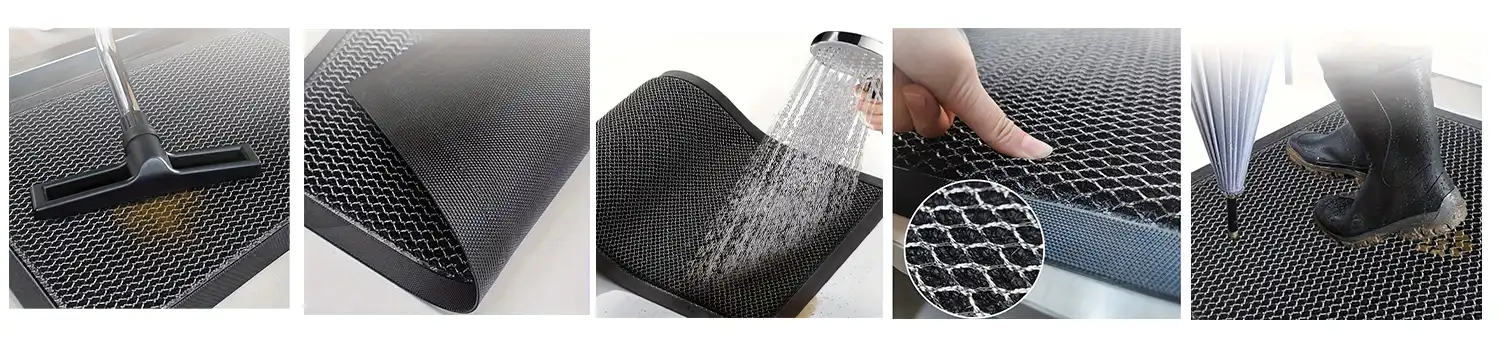
First, use a commercial-grade hoover cleaner with pressure settings that you can change to do a thorough job. Move the hoover across the mat's surface in different directions to free up bits stuck in the mesh holes. This process of dry removal should happen every day in areas with a lot of foot traffic, like building doors, and once a week in areas with less foot traffic. For tough dry dirt, use a soft-bristle broom to gently brush the mat's surface, moving dirt toward the edges so they can be picked up. Do not scrub too hard, as this could change the shape of the mesh or break the elastic net from its rubber backing. This preventative maintenance lowers the number of intense wet cleaning processes, which increases the mat's general life and lowers the cost of maintenance labour.
Deep Cleaning and Wet Treatment Techniques
Mix pH-neutral cleaning solution with hot water according to the directions on the bottle. Use a mop or a low-pressure spray to spread the fluid equally across the mat's surface. Let the cleaning solution stay on the mat for 5 to 10 minutes to break down oils and deep-down dirt without making it too wet. Soft-bristled brushes should be used to gently stir the cleaning solution through mesh holes. Pay extra attention to areas that get a lot of use, like near doors or workspaces. Rinse well with clean water, making sure to get rid of all the detergent leftovers so that soap buildup doesn't cause slips. High-pressure water systems with up to 60 bar of pressure can move dirt and other things out from under the mesh structure, but they need to be used at the right distance and angle to avoid hurting the material.
Stain Treatment for Industrial Contaminants
To get rid of oil-based spots, you need emulsifying agents or degreasing items that are safe for polymer materials. Apply stain remover straight to the stained areas and let it sit for the right amount of time before brushing gently and cleaning. Chemical spills should be cleaned up right away with absorbent materials. Before starting the cleaning process, safety data sheets should be looked at to make sure that the cleaning agents won't react badly with the spilt chemicals.
Occasionally, rust spots from metal tools can spread to mats used in factories. Mild acid-based rust removers that are diluted properly can get rid of these marks without hurting the anti-slip treatment, but it's best to test them first on an area that won't be seen. Write down the best ways to get rid of certain contaminants from stains so that future upkeep answers are easier.
Proper Drying and Post-Cleaning Inspection
Place clean mats in places with good air flow or use air flow devices to help them dry faster. The open-mesh design lets wetness evaporate faster than solid mats, and the mats are usually ready for use in two to four hours, depending on the weather. Direct heat sources above 60°C should be avoided because they could damage the elastic material or split the glue on the back.
During the drying process, look at the mesh structure for tears, separated rubber backing, and areas that look like they've been worn down too much. Finding damage early on lets you decide quickly whether to fix it or replace it, before small problems become dangerous or require a whole new mat. There are 100% pre-shipment quality control processes that make sure the product works the same way from the time it is installed until the end of its service life. These inspection methods are in line with those procedures.
Proven Maintenance Practices to Extend Elastic Mesh Floor Mat Lifespan
Strategic planning for maintenance turns reactive cleaning into proactive asset management, which gets the most out of the money spent on Elastic mesh floor mats.
Establishing Inspection Schedules
Do walk-through checks once a month, paying special attention to areas with a lot of foot traffic where mechanical wear builds up. Check the quality of the mesh to see if it is getting thinner, bending, or coming away from the rubber backing. Keep track of damage over time by taking pictures and making notes about where things were found. This will help you make decisions based on data about shift plans or selective replacement strategies.
Quarterly comprehensive assessments should evaluate the entire mat inventory, measuring thickness at standardized points to detect compression loss. Mats showing more than 15% thickness reduction compared to specifications may require replacement to maintain anti-fatigue properties and compliance with safety standards. This information can help procurement teams make their criteria for choosing suppliers better and work out performance promises for future orders.
Strategic Installation for Reduced Wear
Place mats so that foot traffic spreads out evenly across the surface, rather than collecting wear in narrow pathways. For entrances, stack several mats on top of each other to make the scraping and drying area bigger. This way, each mat can remove some of the dirt without overloading a single unit. This method makes each mat last longer and makes cleaning more effective overall. Consider rotating mats between high-traffic and moderate-use locations quarterly to equalize wear patterns across your mat inventory. This strategy proves particularly effective for retail stores and office buildings where usage intensity varies by season or business cycles. Tracking rotation schedules through simple floor plan documentation helps maintenance teams execute this approach consistently.
Customization Options That Support Maintenance Goals
By working directly with mat makers on OEM and ODM customisation, buyers can choose features that make the mats easier to keep. Custom sizing gets rid of the odd gaps where dirt and dust collect around mats that are too small, and heat transfer printing for logos doesn't fade as easily as surface-applied stickers do after many cleaning cycles.
Solid color options simplify stain visibility and cleaning effectiveness assessment compared to complex patterns that mask soil buildup. During the customisation process, procurement managers should talk about application-specific needs, such as the need to be exposed to certain poisons, the amount of traffic that is expected, and the availability of cleaning resources. Our precision laser cutting and high-definition heat transfer methods allow us to make samples in 24 to 48 hours. This lets buyers check out the maintenance features before committing to large orders, with production cycles as short as 7 days.
Supplier Partnership for Long-Term Performance
Getting in touch with qualified makers who have CE, OEKO-TEX, ISO 9001, REACH, and EN 13501 certifications makes sure that you can get expert help when you run into problems with maintenance. Quality sellers provide paperwork on cleaning protocols, suggestions for suitable products, and troubleshooting help when problems arise out of the blue. This help from experts is very helpful when putting mats down in different places or in different kinds of weather.
Long-term customers benefit from specialised account management, which makes buying easier and lets them know about product improvements or changes to specifications before they happen. Free replacement coverage for quality-related issues like printing flaws, incorrect cutting, or inconsistent sizes removes procurement risk, letting buyers focus on practical deployment instead of managing vendors.
How to Choose the Right Elastic Mesh Floor Mat for Your Business Needs?
Choice of material has a big effect on both the original cost of purchase and the amount of maintenance needed over time, making informed comparison essential for optimal investment outcomes using the right Elastic mesh floor mat.
Comparing Elastic Mesh Against Alternative Materials
Rubber mats are very durable and don't react badly with chemicals, but they don't drain well, which is important for wet areas. Their solid design keeps wetness against the flooring substrates, which could be bad if water pools. Foam options offer better cushioning for anti-fatigue uses, but they forever deflate under long-term loads, so they need to be replaced more often in industrial settings. Elastic mesh floor mats balance these different needs with their designed polymer makeup and open-grid design. The mixture allows for drainage rates of more than 30 litres per minute per square metre, and the structure stays strong even when moving carts and people stand on it for a long time. Because of this, elastic mesh options can be used in a wide range of situations, from hotel doors to workplace assembly lines.
Matching Mat Specifications to Operational Requirements
Standard 9mm thickness is good for indoor uses like office buildings and shops because it makes the space more comfortable without causing trip risks at transition points. The non-slip rubber backing works well on tile, smooth concrete, and finished wood surfaces that are popular in these places. Mats made with UV stabilisers that achieve Grade 4-5 blue wool scale ratings are needed for outdoor setups that are subject to UV radiation and temperature changes. This is to keep the mats from becoming weak and losing their colour.
Heavy-duty versions with a strengthened grid thickness of more than 11 mm and high Shore Hardness scores work well in factories that use forklifts or are exposed to harsh chemicals. For uses that put safety first in regulated industries, procurement teams should ask for tensile strength specs higher than 10 MPa and friction coefficient tests that meet DIN 51130 standards and show R11 or R12 scores.
Evaluating Total Cost of Ownership
Initial purchase price represents only one component of flooring investment analysis. To compare choices, you should figure out how many hours of cleaning are needed, how many upkeep supplies are used, and how often the items are expected to need to be replaced. When compared to materials that need special cleaning methods or regular professional repair services, Elastic mesh floor mats with surface treatments that make them easy to clean have much lower ongoing upkeep costs.
Directly buying from the plant cuts out middlemen and their markups, which improves unit economics, especially for large orders that support operations at more than one site. Flexible minimum order numbers can be used for both small-scale tests and large-scale rollouts. This lets procurement managers check the success of the product before allocating large amounts of money. Export standard packing in the form of a roll, a carton, or a woven bag improves the rate at which containers are loaded, which lowers the cost of operations per unit for foreign shipping.
Conclusion
Elastic mesh floor mats need to be cleaned and maintained properly to protect your flooring investment and uphold safety standards that are essential to running a successful business. This guide explains organised ways to get the most out of mats, such as daily cleaning rules and inspection plans every three months. These help procurement managers and building teams get the most out of mats' performance and lifespan. Strategic agreements between suppliers and makers that offer customisation options, expert support, and quality guarantees turn buying goods into relationships that create value. By following these tried-and-true maintenance tips and picking the right products for your specific needs, you can be sure of getting reliable flooring solutions that pay for themselves in lower replacement costs, higher safety standards in commercial and industrial settings, and better maintenance costs.
FAQ
Q1: How often should commercial facilities clean elastic mesh floor mats?
A: High-traffic areas, like hotel lobbies and building doors, need to be vacuumed every day to get rid of the dirt and dust that builds up in the mesh holes. Deep cleaning once a week with pH-neutral soaps and soft-bristle brushes keeps the look and cleanliness up to par in these tough situations. Places with moderate use, like office hallways or the back of a store, can stretch the dry cleaning cycle to once a week and the wet cleaning cycle to once a month. Chemical or oil spills in industrial settings need to be cleaned up right away, and surfaces need to be thoroughly cleaned once a week, even if they don't look dirty, to keep materials from breaking down in these Elastic mesh floor mats.
Q2: Can harsh chemicals damage elastic mesh floor mats?
A: Strong alkaline cleaners, solvents like acetone or mineral spirits, and bleach-based products can damage the structure of the elastic polymer, which can lead to cracks on the surface and less flexibility. These chemical interactions may cancel maker warranties and make replacements more necessary more quickly. Always use cleansers that are pH-neutral and have been approved for use on synthetic floors. Ask suppliers for cleaning compatibility paperwork when you're buying things so that you can set up the right processes before rollout. Testing new cleaning products on small, unseen places before using them all over protects against unexpected material responses even more.
Q3: Are eco-friendly cleaning methods available for these mats?
A: Plant-based detergent cleaners and enzyme-based products clean well without leaving behind harsh chemicals, which helps with environmental efforts and protects mat materials. Controlled steam cleaning at temperatures below 60°C is a chemical-free way to clean that can be used in healthcare and food service settings that need to meet high standards of cleanliness. These eco-friendly methods are in line with OEKO-TEX approval standards, which means that non-toxic materials are used throughout the whole lifetime of a product, from making it to maintaining it and then recycling it.
Partner with Yiyajia Carpet for Superior Elastic Mesh Floor Mat Solutions
Yiyajia Carpet is a trusted Elastic mesh floor mat seller with 20 years of experience making high-quality products at factory-direct prices. Precision laser cutting and high-definition heat transfer technology are used in our 20,000 m² building to make custom solutions that meet your exact needs for size, colour, and brand integration. We know how hard it is for wholesalers, importers, and project managers to buy things when they need stable quality, low prices, and reliable delivery times. Before being sent out, every mat is inspected carefully to make sure it meets all of your order's requirements for load consistency, backing stickiness, and size accuracy.
Email our team at sale@yyj-carpet.com to talk about your needs for large purchases. You'll get a sample within 24 to 48 hours. Our OEM and ODM services help you realise your brand's goals by offering flexible minimum order amounts, export-standard packaging that is designed to make container loading more efficient, and full compliance paperwork that includes CE, OEKO-TEX, ISO 9001, REACH, and EN 13501 certifications. Long-term partnership benefits include specialised account management, priority scheduling for return orders, full after-sales support, and free replacement covering for problems with quality.
References
1. International Facility Management Association. (2021). Flooring Maintenance Best Practices for Commercial Buildings. Houston: IFMA Press.
2. Johnson, M.R., & Peterson, L.K. (2020). Industrial Safety Flooring: Material Selection and Performance Standards. Boston: Technical Publishing International.
3. Chen, W., & Roberts, D.A. (2022). Polymer Flooring Systems: Durability, Maintenance, and Lifecycle Analysis. London: Materials Science Publishing.
4. American Society for Testing and Materials. (2023). ASTM Standards for Slip Resistance and Floor Mat Testing Protocols. West Conshohocken: ASTM International.
5. Green Building Council. (2021). Sustainable Maintenance Practices for Commercial Floor Coverings. Washington: USGBC Publications.
6. Davidson, R.T., & Liu, S. (2022). Procurement Strategies for Facility Management: Cost Optimization in Flooring Solutions. Singapore: Global Business Press.