_1774494554973.webp)
How often should commercial office carpet rugs be replaced today?
September 22, 2026


Most commercial office carpet rugs need replacement every 5 to 10 years, though this range shifts considerably based on traffic intensity, material quality, and maintenance discipline. A heavy-traffic open-plan office may push a mid-grade office carpet rug to its limit within five years, while a well-maintained executive suite using a high-density crystal velvet commercial rug can sustain professional appearance well past the decade mark. Knowing your replacement cycle in advance is not merely a facilities decision — it directly affects budgeting, brand presentation, and employee well-being.
Understanding the Lifespan of Commercial Office Carpet Rugs
There is no set number for how long carpets last in business settings. Before making any buying decisions, procurement managers and office furniture developers should look at this product, which is made up of a number of factors that affect each other.
Material Composition Drives Durability
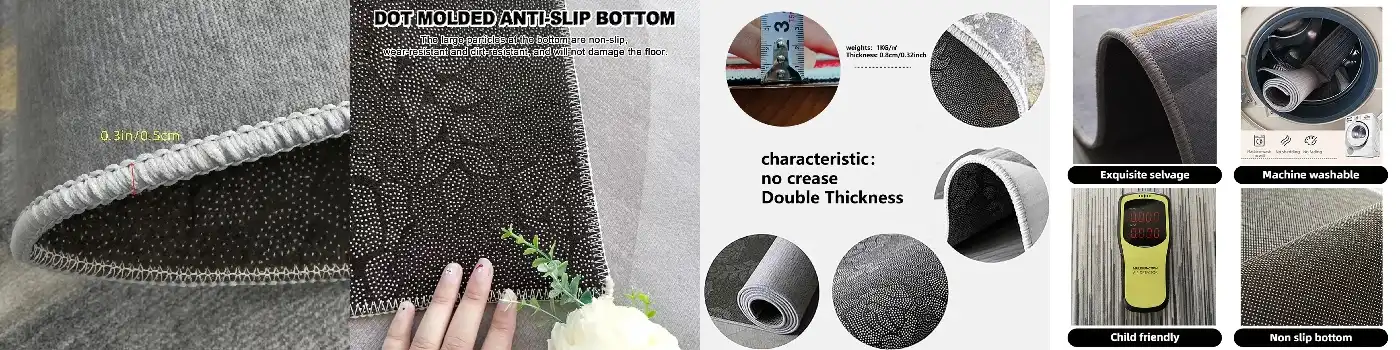
Fiber type is the best way to tell how long something will last. Solution-dyed nylon doesn't break easily and keeps its shape for 10 to 15 years when used in heavy commercial settings. Polypropylene is cheap, but the main lanes will get matt within three to five years. Yiyajia Carpet's commercial collection uses crystal velvet polyester as its surface material. It strikes a good balance between having a luxurious feel and being strong enough to withstand daily castor chair traffic when backed by a dot plastic (PVC) layer reinforced with TPR. With a weight of 750–1,100 g/m² and a thickness of 5 mm, the pile is much more resistant to compression deformation than lighter options.
Traffic Zones and Usage Patterns
Not every working area gets old at the same speed. The Carpet and Rug Institute (CRI) says that places like hallways and entrances get up to four times as much wear and tear as private office spaces. Instead of a single timeline for the whole building, making replacements based on zones lowers the total cost of ownership over a five-year period.
Environmental and Operational Conditions
Changes in humidity, UV light from near big windows, and not properly preparing the base all speed up the deterioration process. Conformity with standards like EN 13501 flame retardancy and ISO 2551 dimensional stability is very important when choosing a product, such as an office carpet rug, because changing levels of moisture can make dimensions less stable, which can lead to raised seams and falling dangers.
Signs It's Time to Replace Your Office Carpet Rugs
The most obvious sign is wear, but it's not always the first sign that something isn't working right. Several signs show up long before the surface looks like it can't be fixed.
Functional and Structural Warning Signs
These are the main signs that you should look at your new plan right away:
- Permanent crush lanes under castor chairs: The fiber structure has failed when the pile doesn't bounce back after cleaning. A good industrial rug that meets EN 985 standards should be able to handle at least 25,000 cycles of a wheeled chair before it starts to behave this way.
- Persistent odor despite deep cleaning: Surface cleaning won't get rid of bacteria growth that's embedded in damaged backing layers. This has a direct effect on indoor air quality (IAQ), which the U.S. EPA says is linked to lower brain function and less work output from employees.
- Edge curling or backing delamination: A strong hem and stable backing, like the machine-woven 0.6cm hem locking on Yiyajia's industrial rugs, prevent this. If the edges curl no matter what, the backing is no longer strong, and tape won't fix the tripping hazard.
- Color fading beyond acceptable brand tolerance: Companies with strict VI standards can't stand color drift that doesn't match their brand palette, especially in reception and boardroom areas where clients can see the furniture.
Taking care of these signs right away will protect the professional environment your customers and workers expect and keep you from being sued.
Best Practices for Extending the Life of Commercial Carpet Rugs
Regular maintenance protects your investment and increases the useful life of your equipment, including an office carpet rug. A five-year replacement cycle and a ten-year replacement cycle are often determined by how well the product is maintained, not just how long it lasts.
Establish a Tiered Cleaning Protocol
In grounds management, it is common to match the regularity of cleaning to the amount of traffic. Here's a structured way to do it:
- Daily: Using a beater-bar vacuum to clean high-traffic areas and workstations gets rid of rough particles before they get into the pile roots.
- Quarterly: Low-moisture encapsulation cleaning crystallizes embedded dirt without washing the backing too much, which is great for keeping offices running smoothly while reducing downtime.
- Annually: Hot water extraction (HWE) improves the look of the pile and gets rid of allergen buildup that other methods can't reach.
Yiyajia's crystal silk surface doesn't stain easily and dries quickly. This cuts down on the time needed to recover after cleaning and lowers the chance of mold growing in the backing layer. These maintenance savings bring down the total cost of upkeep during the warranty period.
Prevention at Entry Points and High-Wear Zones
CRI research shows that putting commercial-grade entry mats at all points of access stops about 80% of tracked-in soil before it gets to the main floor covering. Chair mats made for each zone placed under desks with a lot of castors help reduce focused pile compression even more.
Comparing Carpet Rugs with Other Office Flooring Options
When procurement managers compare flooring systems, they look at more than just the cost per unit. The real value is based on the total cost of ownership, which includes installation, upkeep, sound quality, and how often the product needs to be replaced.
There are measurable benefits to commercial carpet in terms of noise reduction, comfort, and energy efficiency. A carpet with enough pile density has a Noise Reduction Coefficient (NRC) above 0.15, which means it effectively blocks out noise in open-plan spaces. Hard floors can't match this level of performance without expensive acoustic underlays.
Luxury vinyl tile (LVT) and glossy concrete last longer in wet or industrial areas, but they make noise when they hit something and don't keep heat in or out. It is important for employees to be comfortable and have privacy from other sounds in a corporate office, which is why an office carpet rug is often preferred in such environments. A good commercial rug will last longer than hard flooring options when maintenance costs are taken into account.
Procurement Considerations for Commercial Office Carpet Rugs
Selecting the right office carpet rug supplier requires evaluating product specifications, certification compliance, customization capability, and supply chain reliability simultaneously.
What to Verify Before Committing to a Supplier
When making large-scale buying decisions, these are the main factors that should be used for evaluation:
- Certification compliance: For projects in North America, Europe, and the Middle East, EN 13501 flame retardancy, OEKO-TEX, CE, ISO 9001, and REACH certification are musts. All five are owned by Yiyajia Carpet, and full inspection records are provided for each shipment.
- Customization depth: Corporate clients need image integration, colors that fit their brand, and conference tables and open desk groups that aren't the standard size. With a MOQ of 50 pieces, Yiyajia can fully customize the size, color, and logo of your products. Samples can be sent to you in 24 to 48 hours.
- Warranty and durability assurance: A promise that lasts 5–10 years and is based on the material and how it is used gives procurement managers a reasonable budget plan for replacements.
- Logistics reliability: Export-standard packaging, LCL and FCL freight options, and professional customs paperwork lower the risk of being held up at the port, which is very important for meeting project deadlines.
These criteria, applied consistently, eliminate the most common pain points in large-scale commercial flooring procurement and build a foundation for long-term supplier relationships.
Conclusion
Instead of replacing business floor coverings when they start to look worn, replacing them on a plan based on data cuts costs, protects brand environments, and keeps employees comfortable. A basic replacement cycle of 5–10 years works well in most business settings, though this can be changed depending on the zone, traffic, and level of upkeep.
The most reliable way to get to the top of that range is to buy a well-specified product from a reputable company that responds to customer requests, such as an office carpet rug. Yiyajia Carpet's crystal velvet commercial rugs are made to meet this expectation. They are backed by TPR reinforcement, certified to global safety standards, and can be fully customized to meet brand needs.
FAQ
How long does a commercial office carpet rug typically last?
Most office mats made for businesses last between 5 and 10 years. Areas with a lot of foot traffic, like hallways, may need to be replaced every five years or so. Areas with less foot traffic, like private offices or boardrooms, can usually last ten years or more with regular maintenance.
What backing material is best for castor chair environments?
The TPR-reinforced dot plastic backing gives the grip and shape rigidity that a swivel chair needs. It keeps the rug from moving when the chair moves and doesn't come apart when rolled over and over again.
Can corporate logos be integrated into commercial carpet rugs?
Yes. Manufacturers like Yiyajia Carpet offer heat transfer printing and custom weave designs that put names and brand color schemes right into the pile surface. The minimum order quantity (MOQ) is as low as 50 pieces.
What certifications should an office carpet rug meet for U.S. and EU projects?
Check for certifications like CE, OEKO-TEX, ISO 9001, REACH, and EN 13501 to make sure the product doesn't catch fire. These cover the needs of both markets for safety, chemical compliance, and fire performance.
How do I reduce cleaning costs for large office carpet installations?
Pick surfaces that won't stain and materials that dry quickly. When you combine these product features with a tiered cleaning protocol—daily brushing, quarterly encapsulation, and annual hot water extraction—the need for professional cleaning is reduced, and the product lasts longer.
Upgrade Your Office Environment with Yiyajia Carpet
Yiyajia Carpet has been making carpets for 20 years, so they know how to make business office carpet rug projects. Our crystal velvet line is approved by CE, OEKO-TEX, ISO 9001, REACH, and EN 13501. Large orders are sent out within 7 days, and samples are ready in 24 to 48 hours. We can fully customize the name, color, and size of office carpet rugs starting at just 50 pieces. Our customers come from North America, Europe, and the Middle East. To get your sample, email our team at sale@yyj-carpet.com or go to yyj-carpet.com right now.
References
1. Carpet and Rug Institute (CRI). Carpet Maintenance Guidelines for Commercial Installations. CRI, 2022.
2. U.S. Environmental Protection Agency. Indoor Air Quality and Commercial Flooring: Facility Management Best Practices. EPA, 2021.
3. International Organization for Standardization. ISO 4918: Textile Floor Coverings — Determination of the Effect of Furniture with Castors. ISO, 2019.
4. European Committee for Standardization. EN 13501-1: Fire Classification of Construction Products and Building Elements. CEN, 2018.
5. OEKO-TEX Association. OEKO-TEX Standard 100: Testing for Harmful Substances in Textiles. OEKO-TEX, 2023.
6. Facility Management Journal. Total Cost of Ownership in Commercial Flooring: A Comparative Analysis. IFMA, 2020.