_1774494554973.webp)
Custom-Sized Crystal Velvet Utility Door Mat for Home Entrances
September 8, 2026


When evaluating entrance flooring solutions for wholesale distribution, understanding the technical specifications and performance metrics becomes paramount. A utility door mat manufactured with crystal velvet technology represents an engineered solution that balances commercial durability with residential aesthetics. These mats utilize fine faux cashmere surfaces paired with TPR thermoplastic rubber backing, creating a moisture-trapping system capable of withstanding frequent foot traffic while maintaining visual appeal. For building materials distributors serving North American retail chains, selecting the right entrance matting solution directly impacts customer satisfaction and repeat order volumes.
Understanding Utility Door Mats and Their Strategic Importance
Defining the Technical Role of Entrance Matting Systems
As mechanical soil containment barriers, entrance matting systems are meant to catch particles before they move into internal areas. How well these systems work is shown by how well they keep 80–90% of the debris that comes in within the first six feet of the building. Different types of crystal velvet use solution-dyed synthetic fibers that keep their color even when exposed to UV light and absorb more water than traditional polypropylene alternatives. Good entry mats are usually made of two levels. This makes channels that catch dirt below the walking surface, so it doesn't get spread to other areas where people walk.
Core Benefits Driving B2B Procurement Decisions
When purchasing entrance mats, procurement managers look at three measurable outcomes: fewer interior maintenance tasks, less liability for slip-and-fall accidents, and longer flooring investments' lifespan. According to research from the International Sanitary Supply Association, effective door matting cuts the cost of cleaning the inside of a building by about 65% per year. Crystal velvet mats are designed to solve the moisture management problems that are common in North American climates, where regular rain causes chronic tracking problems. The material dries quickly, which stops bacteria from growing and smells from developing, which is a frequent problem with natural fiber choices in damp places.
Custom Sizing as a Competitive Differentiation Factor
Standardized mat sizes often leave covering gaps in business setups, which makes the system less efficient as a whole. Distributors can exactly meet architectural requirements with custom-sized setups, which get rid of the need for multiple units that overlap and pose a trip risk. For buildings with non-standard entry configurations, like older business buildings that are popular in established urban areas, custom measurements are needed to make the integration go smoothly. Distributors can serve mid-market customers who can't commit to the large orders that are usually needed for custom goods by offering flexible sizes and low minimum order amounts (50 pieces for dimension customization).
Key Features of Crystal Velvet Utility Door Mats: Materials and Performance
Advanced Material Composition and Structural Engineering
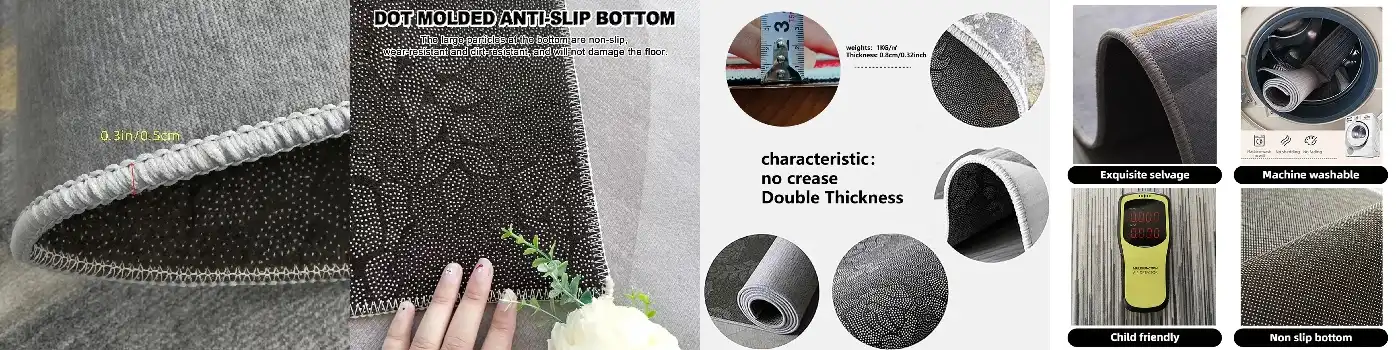
When you mix synthetic fiber technology with thermoplastic backing systems for a utility door mat, you get performance benefits that you can't get with traditional rubber-backed or coir options. High-denier fake cashmere fibers are used on the surface to make it feel soft to the touch while still being resistant to crushing when compressed for a long time. When it comes to dimensional stability, TPR thermoplastic rubber backing is better than recovered rubber materials, which tend to curl at the edges after multiple wet-dry cycles. According to the American Society for Testing and Materials, this backing material stays flexible at temperatures ranging from -20°F to 140°F. This means that it will work the same way all year long in North America.
Performance Metrics in High-Traffic Commercial Environments
To test for durability, you have to look at the tuft bind strength, delamination resistance, and edge integrity under rapid wear methods. According to ASTM D1335 testing standards, good crystal velvet mats have tuft bind strengths greater than 10 pounds. This keeps fibers from coming loose during commercial vacuum extraction cleaning. The edge-locking stitching and machine-woven construction keep the fabric from fraying, which is a major problem with cheaper options that leads to early replacement cycles. It can hold up to 1.2 gallons of water per square yard, which is enough to keep the surface from tracking water during rainstorms without becoming so wet that it loses its anti-slip qualities.
Environmental Compliance and Sustainability Credentials
Environmental certifications that prove safe materials and responsible manufacturing methods are becoming more and more required in modern procurement requirements. Following CE and ROHS rules makes sure that goods follow the rules set by the European Union for dangerous substances. This lets them reach markets around the world through different distribution methods. The OEKO-TEX certification is very specific about textile safety; it makes sure that no harmful chemicals are used at any point in the production process. These certificates lower the risk of buying for wholesalers who work with institutions that have strict rules about buying environmentally friendly products. These include healthcare and educational facilities that have to meet strict non-toxic standards.
How to Choose the Right Custom Entrance Mat for Your Distribution Portfolio?
Implementing the F-1 Criteria Screening Methodology
The F-1 method bases purchasing choices for a utility door mat on five measurable factors: the face weight, the friction coefficient, the functional range, the quality of the fabrication, and the cost-effectiveness. Face weights between 24 and 32 ounces per square yard show that the fiber density is good enough for business uses without costing too much. When it's wet, slip resistance is guarantyd by friction coefficients that meet NFSI High-Traction standards (usually >0.60 dynamic coefficient). The functionality review checks to see if the product is only useful in one setting or if it needs to work well in a number of different places in the distribution customer's facilities.
Matching Product Specifications to End-User Requirements
Building material stores usually have three different types of customers: people who are remodeling their homes, people who manage commercial properties, and people who are building new homes. In each section, different success factors are given more weight. Residential buyers want a variety of looks and easy upkeep, so they need a wide range of colors and specs that say the fabric can be washed in a machine. When property managers buy things, they look at the total cost over their whole life and demand longer warranties and confirmed data on durability. Construction specs call for proof of compliance and planning of delivery schedules. This puts a lot of value on providers who have already completed similar projects successfully.
Evaluating Supplier Production Capacity and Logistics Infrastructure
Seasonal changes in demand for building materials cause capacity problems during busy times, which in North American markets usually happen from September to November. Suppliers who keep their daily production capacity at 2,000 square meters can handle sudden jumps in volume without having to wait longer for parts, which makes it harder for stores to plan their inventory. How well you package things has a direct effect on how many containers you use, which is a key cost factor when FOB prices pass on the cost of freight to the buyer. When compared to inefficient packaging methods that waste cubic capacity, optimized packaging configurations that achieve 95% or more container density lower logistics costs by 30 to 40 percent per unit.
Installation and Maintenance Guidelines for Commercial Applications
Proper Positioning and Securing Procedures
An important part of a good fitting of a utility door mat is checking the subfloor to make sure it is straight and won't curl or buckle in the middle. Most of the time, crystal silk mats with TPR backing don't need to be glued down on the inside because the rubber compound grips smooth floors well enough. In order to meet ADA standards, mat edges can't move more than 0.25 inches vertically. This means that mats that are thicker than the standard thickness must have beveled edge profiles. To catch the dirt that people kick up as they walk through the front door, entrance mat systems should go 12 to 15 feet into the building. However, in retrofit situations, room constraints often mean that installations can only go 6 to 10 feet in.
Maintenance Protocols That Extend Service Life
Regular maintenance keeps the mat looking good for as long as possible and keeps it from needing to be replaced too soon. Daily cleaning gets rid of surface particles before they get stuck in fiber structures, which keeps the mat's ability to scrape. Using hot water extraction systems once a week to clean gets rid of oils and fine sediments that vacuuming can't reach. Mats that are used at business openings that get a lot of foot traffic benefit from rotation plans that spread out wear patterns evenly across the surface area. When you clean properly, you can keep the pile fibers from matting and crushing, which lowers their performance and is usually the main reason why industrial installs need to be replaced.
Warranty Expectations and After-Sales Support Standards
Suppliers who care about quality offer clear guarantee terms that cover production flaws like delamination, edge separation, and premature pile loss. Usually, warranties last between 12 and 24 months from the date of delivery, and if a product fails before its expected service life is up, it can be replaced in part. Dedicated account management for big buyers makes sure that quality issues are dealt with quickly, and replacement choices are made within 24 to 48 hours. Documentation packages with material safety data sheets, compliance certificates, and care instructions help educate end users and make it easier for distributors to help customers.
Market Analysis and Strategic Procurement Considerations
Competitive Landscape in the Entrance Matting Category
The market for Entrance mat products is split into three groups: low-cost synthetic options, mid-range blended options, and high-end engineered options. The price range for crystal velvet mats is between average and expensive. They cost 15 to 30 percent more than basic polypropylene mats but last 200 to 300 times longer. There is a rising desire for products that look good and last a long time in the business world as property managers look for ways to keep things looking professional without having to replace them all the time. The move toward thermoplastic backing systems shows that the industry is moving away from old rubber compounds that are hard to get rid of when they're no longer useful.
Why Crystal Velvet Technology Delivers Superior Value Proposition
Crystal velvet mats solve a lot of problems in one go: they look good in business settings but also look good in homes, don't have the smell problems that come with natural fiber mats, and keep working well in all kinds of weather. The material dries quickly, which lowers the chance of bacteria taking hold. This is an important factor to consider in healthcare and food service settings where cleanliness standards directly affect licenses. When installed in direct sunlight, color-fastness under UV exposure stops the fading that lowers curb appeal. This means that replacement cycles are 40–60% longer than with traditional dyed options.
Optimizing Supplier Relationships for Long-Term Value
A good relationship between a wholesaler and a seller goes beyond just negotiating prices. It also includes coordinating production schedules, making sure that quality standards are met, and working together on new products all the time. Suppliers that allow for flexible customization and low minimum order amounts (50 pieces for size and color changes) let sellers try how well a product does in the market without taking on too much inventory risk. Customizing logos in just seven days helps business buying programs and property management branding efforts, which is a big source of income for building materials distributors. Transparency in production, such as building certifications and process documents, boosts trust, which in turn supports long-term supply deals with stable pricing.
Conclusion
Crystal velvet entrance matting for a utility door mat is a well-thought-out solution to the problems that North American building materials distributors face when they serve a wide range of commercial and residential customers. The look of the faux cashmere surface combined with the performance of the TPR thermoplastic backing makes it worth being positioned as a premium product while still being accessible thanks to easy customization options and low minimum order requirements. Professionals in charge of buying things can be sure that these items will meet strict environmental standards, lower upkeep costs, and offer the flexibility in size needed for complicated architectural uses. The strategic value goes beyond the performance of each individual product and includes the dependability of suppliers, the guaranty of production capacity, and support structures that keep delivery risk to a minimum after the sale.
FAQ
Q1: What custom size options are available for bulk procurement orders?
A: Crystal velvet mats can be customized in all dimensions, and you only need to order 50 pieces of each size. Standard business sizes, like 40x60cm and 50x80cm, are kept in stock so they can be sent out right away. Custom sizes, on the other hand, can be made to fit architectural needs for non-standard entry layouts. Precision laser cutting technology that keeps edges clean without fraying lets manufacturers make things in a wide range of shapes.
Q2: How does durability compare with rubber-backed entrance mat alternatives?
A: When compared to recovered rubber materials, TPR thermoplastic backing is more stable at the edges and more consistent in size. The material stays flexible at very high and very low temperatures, and it doesn't break down or curl after a while like most rubber-backed goods do. The tuft bind strength is higher than the industry standard, which keeps fibers from coming out too soon during commercial cleaning.
Q3: Are these products suitable for environmentally conscious procurement specifications?
A: Crystal silk mats have certificates from CE, ROHS, and OEKO-TEX that show they meet international safety and environmental standards. Because the process of making the products doesn't use any dangerous chemicals, they can be used in sensitive places like schools and hospitals... The presence of volatile organic compounds and allergens that could affect the quality of the air inside is confirmed by a baby-safe certification.
Partner with a Proven Utility Door Mat Supplier for Your Distribution Needs
Yiyajia Carpet combines advanced manufacturing with flexible customization services made just for wholesale buyers and distributors of building materials. Our daily production capacity of 2,000 square meters makes sure that we always have stock on hand, and our low MOQ of 50 pieces for custom size and color lets you test the market without making a big commitment. We keep all of the necessary compliance standards, such as CE, ROHS, and OEKO-TEX, up to date and can give your business clients the paperwork packages they need. Heat transfer printing and laser cutting can handle any design requirement, from adding a company name to making complicated geometric shapes. Email our purchasing agents at sale@yyj-carpet.com to talk about your particular needs and get full product samples sent to you quickly.
References
1. Floor Covering Weekly. (2024). Market Trends in Commercial Entrance Matting Systems. https://www.floorcoveringweekly.com/
2. International Sanitary Supply Association. (2022). Cost-Benefit Analysis of Entrance Matting Systems in Commercial Facilities. https://www.issa.com/
3. National Floor Safety Institute. (2023). High-Traction Surface Standards for Commercial Entrance Mats. https://www.nfsi.org/
4. Building Materials Dealer Magazine. (2023). Procurement Strategies for Wholesale Floor Covering Distribution. https://www.bdcnetwork.com/